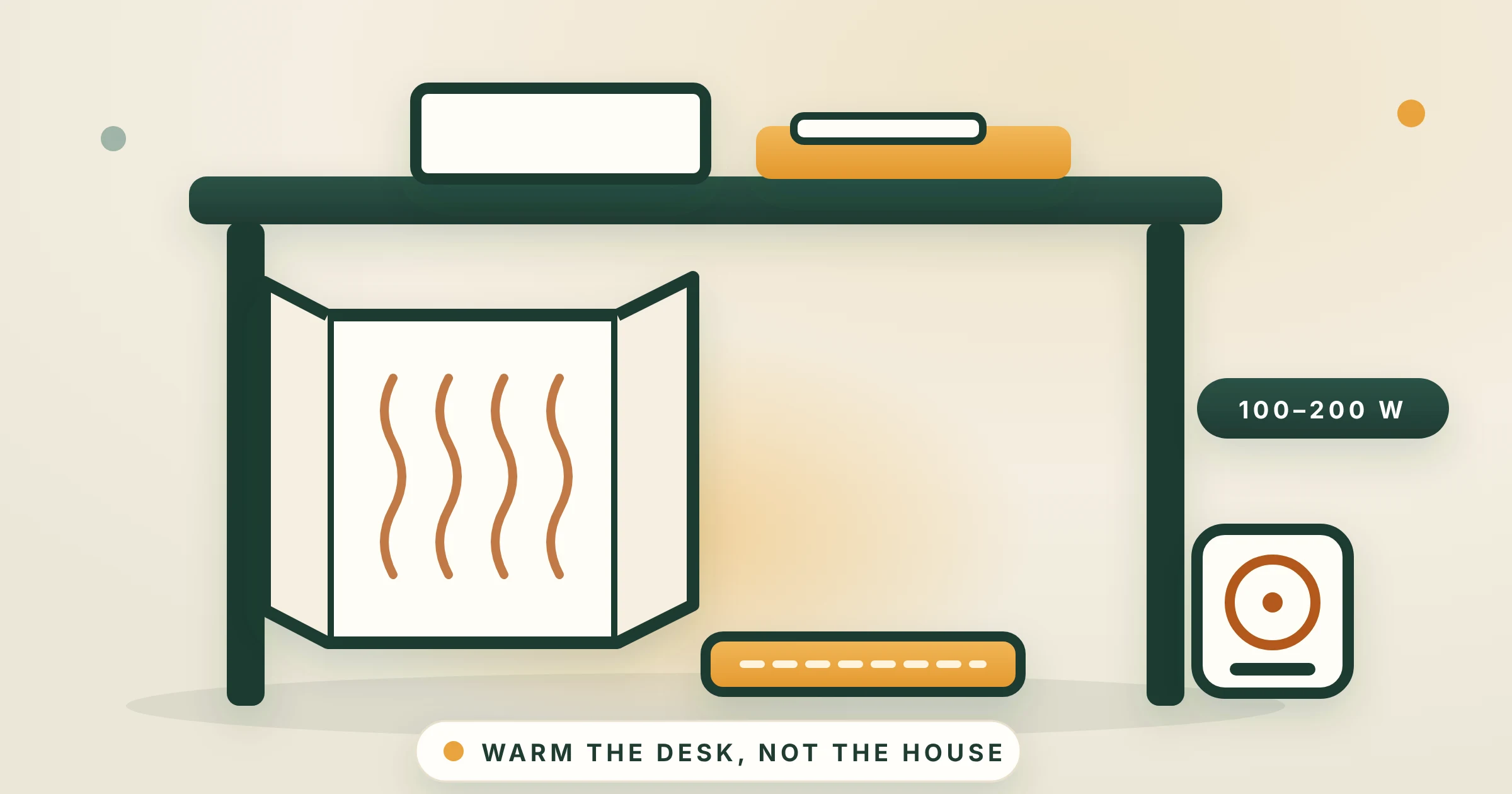
When you work from home, the thermostat stays up all day so one person can sit still at one desk. Sitting still is exactly when you feel the cold, especially in your feet and legs. The cheap fix is to heat you, not every room: a foot warmer or a leg heater under the desk draws 100 to 200 watts. A space heater on high draws 1,500.
Pick a heated foot mat or footrest for cold feet, or a leg panel with a blanket if your whole lower half is cold. At 18 cents per kWh, a 120-watt foot warmer costs about 2 cents an hour, about $3.60 a month for workdays. The money is saved when you turn the thermostat down while you work: the Department of Energy says 7–10°F for 8 hours a day can save up to 10% a year on heating. Our picks: the Cozy Products foot warmer mat, the Toasty Toes footrest and the SOPHRAY leg warmer.
Affiliate note: As an Amazon Associate, The Low Bill Home earns from qualifying purchases. Buying through our links costs you nothing extra. We have not tested every product hands-on: picks are based on the makers' published specs, official energy-saving guidance and long-term buyer feedback, and we say where a product falls short.
Rubber heated mat, about 120 W, thermostatically controlled; rests flat under the desk.
Check price on AmazonWhy we picked it ↓About 100 W, flat, angled or upright, with a fleece cover and Hi/Lo switch.
Check price on AmazonWhy we picked it ↓Folding 200 W panel that wraps your legs, with a blanket, 3 heat levels and a timer.
Check price on AmazonWhy we picked it ↓Shopping on Black Friday? Add it to your Amazon cart now so it is ready when the deals start (Black Friday is November 27, Cyber Monday November 30, 2026).
What each type costs to run
The cost of any electric heater is simple arithmetic: watts ÷ 1,000 × hours × your rate. Here it is at 18 cents per kWh, about the U.S. average EIA expects for 2026, for an 8-hour workday and 21 workdays a month, at full power.
| Heater | Watts | Per hour | Per workday | Per month |
|---|---|---|---|---|
| Heated foot mat | 120 | 2.2¢ | 17¢ | $3.63 |
| Heated footrest | 105 | 1.9¢ | 15¢ | $3.18 |
| Leg panel with blanket | 200 | 3.6¢ | 29¢ | $6.05 |
| Mini ceramic fan heater | 500 | 9¢ | 72¢ | $15.12 |
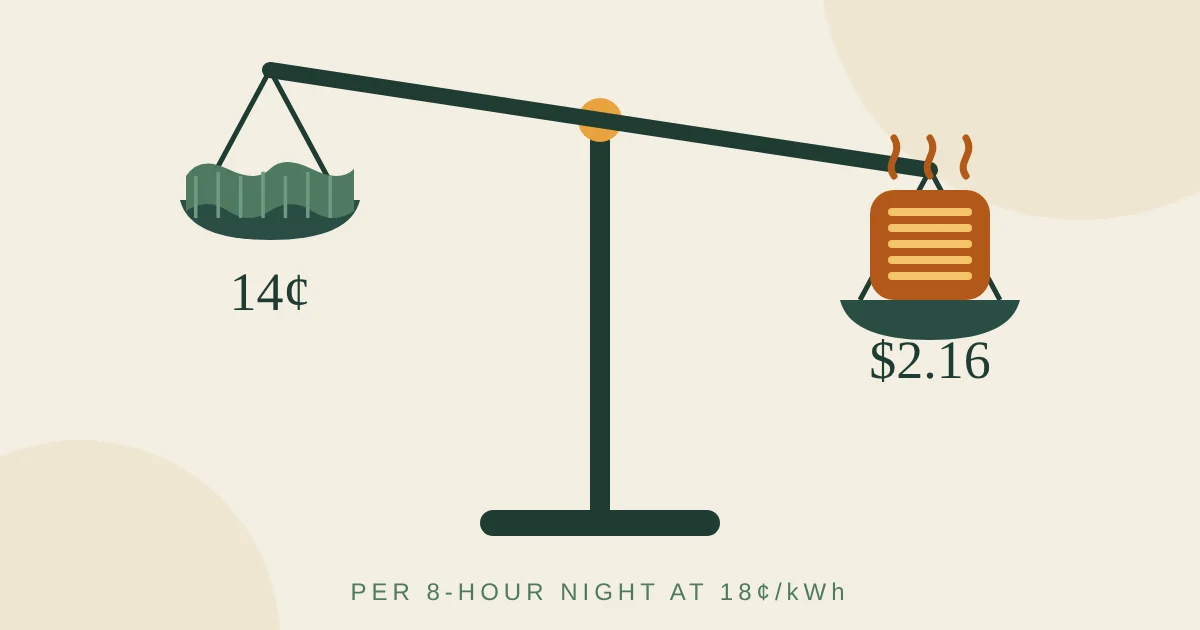
| Space heater on high | 1,500 | 27¢ | $2.16 | $45.36 |
Heaters with a thermostat or a low setting cycle on and off, so real costs are usually lower than these full-power numbers. Want your own numbers? Use the calculator.
Desk heater cost calculator
What a desk heater costs you
| Heater | Watts | Per day | Per month | Per winter (5 months) |
|---|---|---|---|---|
| Heated foot mat | 120 | – | – | – |
| Heated footrest | 105 | – | – | – |
| Leg panel with blanket | 200 | – | – | – |
| Mini ceramic heater | 500 | – | – | – |
| Space heater on high | 1,500 | – | – | – |
Full-power costs. Your rate is on your electric bill: divide the total by the kWh used. Want to compare with turning the whole house down? Try the space heater vs central heat calculator.
Where the saving really comes from
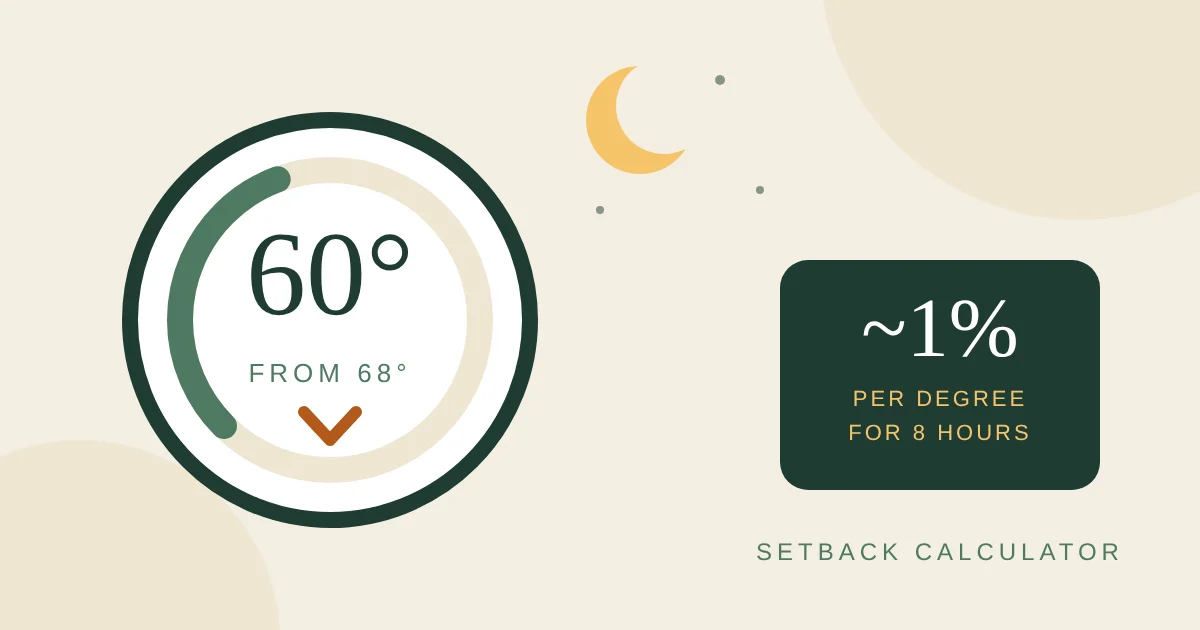
A foot warmer does not lower your bill by itself: it adds a few cents a day. The saving comes from what it lets you do: turn the thermostat down while you work and still be comfortable. The Department of Energy says turning your thermostat back 7–10°F for 8 hours a day can save up to 10% a year on heating. Our thermostat setback calculator works that out for your fuel.
A rough example: EIA expects a home heated with electricity to spend about $1,196 this winter (November to March). If a work-hours setback saves even 5% of that, it is about $60 over the season, against about $18 to run a 120-watt foot warmer for the same five months. With gas heat, the saving is smaller and the math is closer, so pair the foot warmer with a heated throw over your lap and a draft stopper on the office door.
Heat pump? Deep setbacks can make a heat pump use its backup electric strips when it recovers. Keep setbacks small, a few degrees, and let the foot warmer do the rest.
Which type do you need?
| If you feel cold in… | Choose | Typical watts |
|---|---|---|
| Your feet, on a hard floor | Heated foot mat | About 100–135 |
| Your feet, and you like a footrest | Heated footrest | About 90–105 |
| Feet, ankles and legs | Folding leg panel with a blanket | About 200–300 |
| Your hands and wrists | Heated desk pad | Low; maker does not list it |
| The whole desk area, quickly | Mini ceramic fan heater | About 500 |
How we chose
- Low wattage first. We favored products that heat you directly at 100–200 watts over fan heaters that heat the air.
- Safety features. Thermostatic control, overheat protection, auto shut-off timers or tip-over switches, as listed by the makers.
- Track record. Cozy Products has made office foot warmers for years; we looked for long buyer feedback on durability and hot spots.
- In stock with U.S. delivery when we checked on October 20, 2026.
We have not tested these products in our own home. Picks are based on the makers’ published specifications and patterns in buyer feedback. Wattages are the makers’ figures; where a listing gives two numbers, we say so.
The picks
Cozy Products Electric Foot Warmer Heat Mat
A simple, long-selling idea: a rubber mat with a heating element inside that lies flat under the desk. You rest your feet on it, with or without shoes, and it warms them directly. Cozy Products lists it at 120 watts, thermostatically controlled to hold a steady temperature, with the element sealed in waterproof rubber so it can sit on tile or concrete. It rolls up to store or take to an office.
- About 120 W (maker’s figure)
- Thermostatically controlled
- Waterproof rubber, 3 settings
- Rolls up for storage
Good: the cheapest way to warm cold feet, silent, nothing to knock over.
Watch out: the surface gets hot, so the maker advises against delicate floors; heavy mat (about 5 lb); warms feet only.
Skip it if: your legs are cold too: the leg panel covers more.
Cozy Products Toasty Toes Heated Footrest
If you already want a footrest, this one is also a heater. It sits flat, tilts as an angled footrest or stands upright as a small heated panel aimed at your shins. There is a Hi/Lo/Off switch, a fleece cover and an indicator light. The listing gives two wattages, 90 and 105 watts; either way it is the lowest-power pick here, around 2 cents an hour at 18 cents per kWh.
- About 90–105 W (listing gives both)
- 3 positions: flat, angled, upright
- Hi / Lo / Off switch, LED indicator
- Fleece cover included
Good: ergonomic footrest you would use anyway, very low power, light.
Watch out: gentle heat, not for a freezing room; plastic body.
Skip it if: you want strong heat fast: the leg panel is warmer.
SOPHRAY Foldable Under-Desk Leg Warmer with Blanket
A folding fabric panel that stands under the desk and wraps around your legs like a three-sided screen, with a soft blanket to drape over the top so the heat stays around you instead of drifting off. It uses carbon crystal heating film with three heat levels and a 3, 6 or 9-hour timer. SOPHRAY lists overheat, over-current and over-voltage protection and a tip-over switch. Unfolded it is 48 by 23 inches, big enough for tall people.
- About 200 W heat output (listing title says 235 W)
- 3 heat levels, 3/6/9-hour timer
- Overheat and tip-over protection (per maker)
- 48 x 23 in unfolded, folds to 18 in wide
Good: warms feet and legs together, blanket traps the heat, timer for peace of mind.
Watch out: bulkier than a mat; a newer third-party brand rather than a long-established one.
Skip it if: your desk has little legroom or a modesty panel in the way.
Heated Desk Pad (31.5 x 13 in)
Cold hands are the other work-from-home complaint, and a foot warmer does nothing for them. This heated desk mat doubles as a large mouse pad and keyboard pad and warms your hands and wrists while you type. It has three heat levels from about 104 to 122°F and switches off after 4 hours. The maker says it is UL and FCC certified but does not publish the wattage, so we cannot give a cost per hour; heated pads of this size are typically low-power.
- 31.5 x 13 inches, PU leather surface
- 3 heat levels, about 104–122°F
- 4-hour auto shut-off
- Two-prong U.S. plug, 110 V
Good: warms the hands you type with, works as a regular desk mat off-season.
Watch out: wattage not listed; third-party seller; warms only your hands and wrists.
Skip it if: only your feet get cold.
Amazon Basics 500 W Mini Ceramic Heater
Sometimes you want the air around the desk warmer, not just your feet. This tiny ceramic fan heater (under 6 inches tall, 1.4 pounds) runs at 500 watts, a third of a full-size space heater, and has tip-over protection. It heats fast but costs four to five times as much to run as a foot mat, and the warm air drifts away from you, so use it for short warm-ups, not all day.
- 500 W, ceramic element with fan
- Tip-over protection
- About 48 dB (maker’s figure)
- Sold and shipped by Amazon
Good: fast heat, very small, low price.
Watch out: the most expensive to run here; fan noise; needs clearance from papers, bags and blankets.
Skip it if: you will run it all day: a foot mat costs a fraction as much.
Safety rules for heaters under a desk
The space under a desk collects paper, bags, cables and blankets, which is exactly what a heater must be kept away from. The Consumer Product Safety Commission estimates that portable heaters are involved in about 1,700 fires a year. Its rules apply to anything that gets hot:
- Plug it straight into a wall outlet, not a power strip or extension cord.
- Keep 3 feet clear around fan heaters: no papers, bags, curtains or blankets.
- Use only the blanket or cover that came with it. Do not drape an extra blanket over a heater that was not designed for it.
- Keep the cord out from under chair wheels and feet, and check it for damage.
- Turn it off when you leave the desk, or use the timer.
- Reduced feeling in your feet? Ask your doctor before using any heated foot product, and never fall asleep on one.
FAQ
How much does an under-desk heater cost to run?
Multiply the watts by the hours, divide by 1,000 and multiply by your electricity rate. At about 18 cents per kWh, a 120-watt foot warmer costs about 2 cents an hour, or about 17 cents for an 8-hour workday. A 1,500-watt space heater costs about 27 cents an hour, or about $2.16 a day.
Does a foot warmer actually lower my heating bill?
Only if you turn the central heat down while you use it. A foot warmer on its own adds a little to the electric bill. The saving comes from lowering the thermostat: the Department of Energy says turning it back 7 to 10 degrees for 8 hours a day can save up to 10% a year on heating.
Are under-desk heaters safe?
Low-wattage foot mats and panel warmers run much cooler than a fan heater, but any heater needs care. Plug it straight into a wall outlet, keep papers, bags and blankets that were not made for it away from it, keep the cord out from under chair wheels, and turn it off when you leave the desk.
Can I plug an under-desk heater into a power strip?
The Consumer Product Safety Commission advises plugging space heaters directly into a wall outlet, not an extension cord or power strip. That advice matters most for 500 to 1,500-watt heaters; check the manual of any heated product for the maker's rule.
What is better, a foot warmer or a small space heater?
For one person sitting still, a foot warmer or leg panel usually. It puts gentle heat where you feel cold for 100 to 200 watts. A small fan heater warms the air around the desk faster, but uses 500 watts or more and much of the heat drifts away.
Keep going
- Best smart thermostats to turn the heat down automatically while you work
- Heated blanket vs space heater: what each costs to run
- How much does a space heater cost to run?
- Thermostat setback calculator
- 20 ways to lower your heating bill this winter
Sources

Email me at hello@thelowbillhome.com. I read every message, and when a rate, a rule or a product changes, I update the guide. — Eugene
Affiliate Disclosure: The Low Bill Home is a participant in the Amazon Services LLC Associates Program. As an Amazon Associate we earn from qualifying purchases, at no extra cost to you. Product details and availability change, so check the listing before you buy.