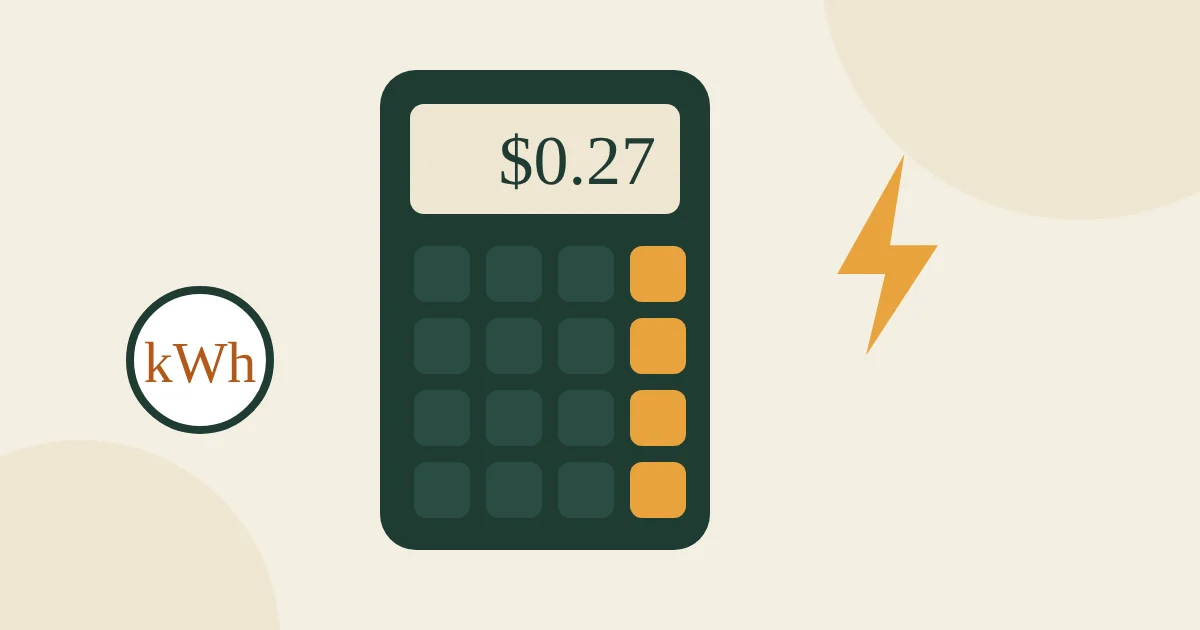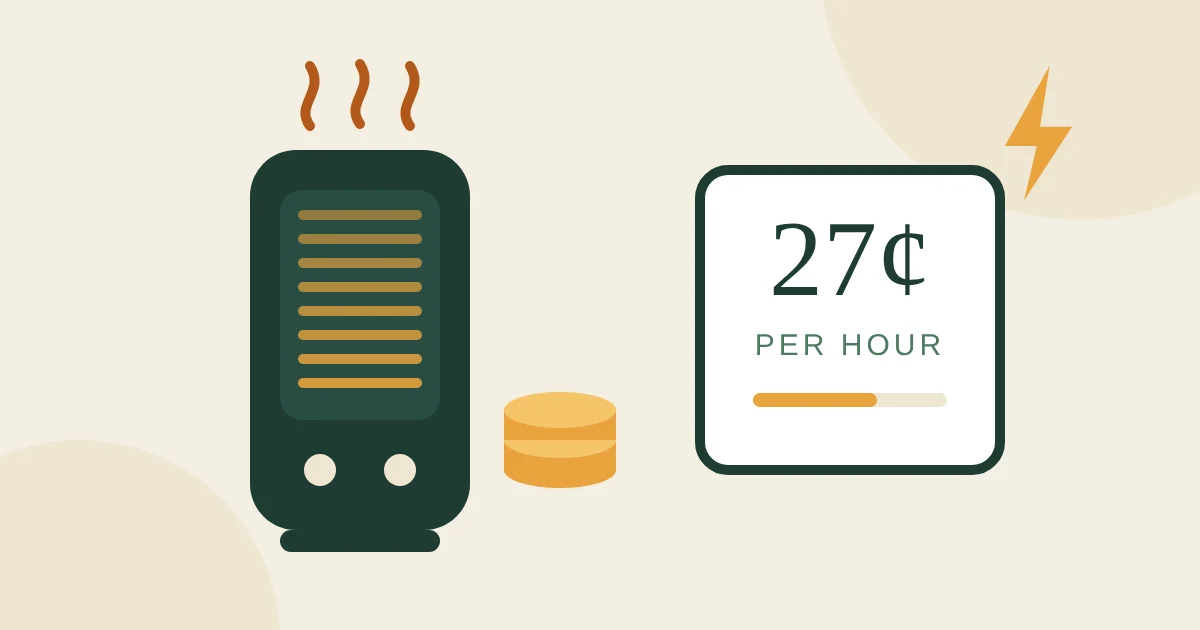
Most space heaters draw 1,500 watts on high and about 750 watts on low. At 18¢ per kWh, close to EIA’s 2026 U.S. average residential rate:
High: about 27¢ an hour, $2.16 for an 8-hour day, about $65 a month.
Low: about 13.5¢ an hour, $1.08 for an 8-hour day, about $32 a month.
Electric rates vary a lot from state to state, so the most useful number is the one on your own bill. Put it into the calculator below.
Space heater cost calculator
Uses – kWh per month. *Per year assumes the same use every month. The rate starts at 18¢, close to EIA’s 2026 U.S. average; change it to the rate on your bill.
Find your rate: divide the total on your electric bill by the kWh you used that month. That gives your all-in price per kWh, including delivery charges. To compare states, see EIA’s average price by state.
Monthly cost by hours of use
At 18¢ per kWh, 30 days a month:
| Hours a day | High (1,500 W) | Low (750 W) |
|---|---|---|
| 2 hours | $16.20 | $8.10 |
| 4 hours | $32.40 | $16.20 |
| 8 hours | $64.80 | $32.40 |
| 12 hours | $97.20 | $48.60 |
These are worst-case numbers for a heater running nonstop. A heater with a built-in thermostat cycles off once the room is warm, so in a small, well-sealed room the real cost is often lower.
The formula
Watts ÷ 1,000 × hours × price per kWh = cost. A 1,500-watt heater running for one hour uses 1.5 kWh. At 18¢, that is 1.5 × 0.18 = 27¢.
Is a space heater cheaper than central heat?
Per unit of heat, usually not. Every electric resistance heater turns electricity into heat at close to 100% efficiency, but electricity is an expensive way to buy heat compared with gas or a heat pump. With example prices of 18¢ per kWh and $13.50 per thousand cubic feet of gas:
| Heat source | Approximate cost per million BTU of heat |
|---|---|
| Gas furnace, 90% efficient | about $14 |
| Heat pump, average efficiency of 2.5 | about $21 |
| Space heater or any electric resistance heat | about $53 |
So a space heater only saves money when it lets you turn the whole-house thermostat down a lot while you heat the one room you are using: a home office during the day, or a bedroom at night with the door closed. If the central heat stays at the same setting, the space heater is pure extra cost.
How to spend less on a space heater
- Use the thermostat or eco mode, not continuous high. The heater cycles off when the room is warm.
- Heat a small room with the door closed. A space heater cannot keep up with an open-plan living area.
- Seal the room first. Drafts undo a space heater fastest; see our guide to stopping window and door drafts.
- Use a heated blanket at night. At about 100 watts it costs under 2¢ an hour at 18¢ per kWh. See the best heated blankets on our sister site.
- “Energy-efficient” claims are mostly marketing. A 1,500-watt ceramic, oil-filled or infrared heater makes the same amount of heat for the same electricity. The differences are in how they spread heat, how quiet they are and their safety features.
Safety first
Plug space heaters directly into a wall outlet. Never use an extension cord, power strip or smart plug: heaters draw close to the limit of a standard circuit and can overheat them. Keep the heater at least 3 feet from anything that can burn, choose one with tip-over and overheat shutoff, and turn it off when you leave the room or go to sleep.
Which space heater to buy
If you do need one, choose a model with a real thermostat, tip-over and overheat protection and a safety certification such as UL or ETL. Our sister site Smart Home Shields compared the best space heaters for different rooms.
FAQ
How much does it cost to run a space heater for 8 hours?
About $2.16 on high (1,500 W) and about $1.08 on low (750 W) at 18 cents per kWh. Multiply by about 30 for a month.
Do energy-efficient space heaters use less electricity?
Not for the same heat output. All electric resistance heaters convert almost all of their electricity into heat, so a 1,500-watt model uses 1.5 kWh an hour on high regardless of type. A good thermostat and a well-sealed room save more than the heater type.
Is it cheaper to run a space heater or central heat?
Central heat is usually cheaper per unit of heat, especially with gas or a heat pump. A space heater saves money only if you turn the central thermostat down substantially and heat just the room you are in.
Can I plug a space heater into a power strip or smart plug?
No. Heater makers and fire safety groups say to plug space heaters directly into a wall outlet. Power strips, extension cords and most smart plugs are not designed for a continuous 1,500-watt load.
Want to check other appliances? Use the full energy cost calculator, or read 20 ways to lower your heating bill.