 By
By Does turning the heat down at night actually save money, or does the furnace just burn it all back in the morning? It is the most common heating question there is, and the honest answer depends on one thing: what heats your home. With a gas furnace, a boiler or electric baseboards, a nightly setback is the biggest free saving you have. With a heat pump, the same habit can save nothing, or even cost you. This page lets you work out your own number, then shows how to set a schedule that you will actually stick to.
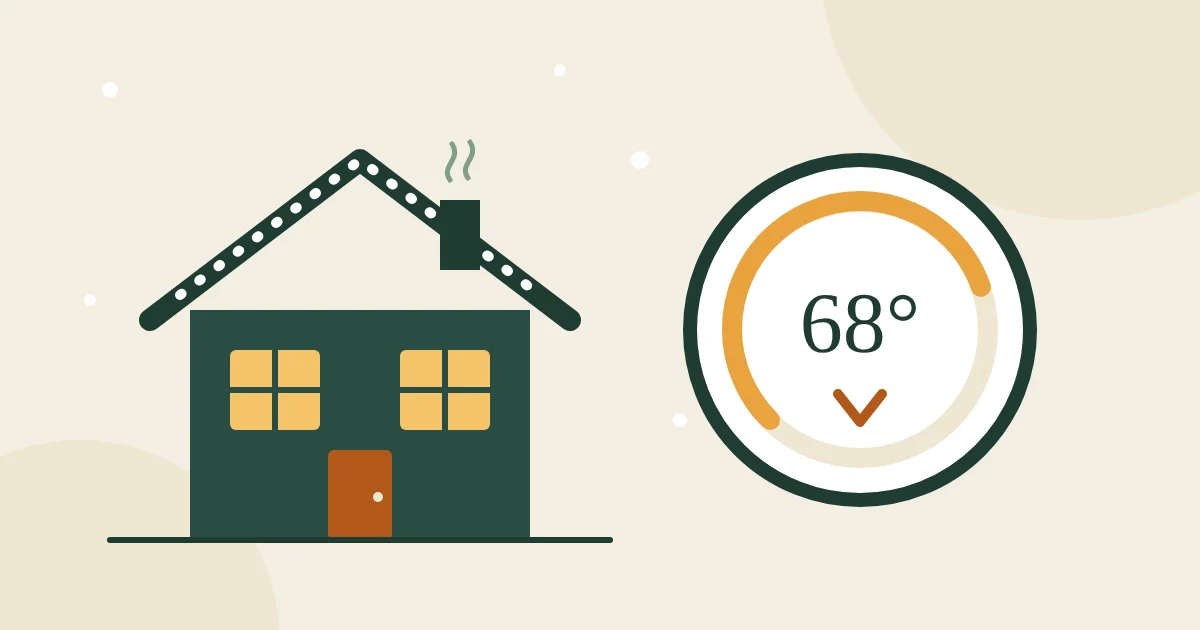
The Department of Energy says setting your thermostat 7–10°F lower for 8 hours a day can shave as much as 10% a year off your heating bill. That works out to roughly 1% per degree held for 8 hours. For an average gas-heated home that is about $51 a winter from a nightly 8-degree setback, and about $169 for a home on heating oil. Add a setback while you are at work and the saving nearly doubles. Heat pump owners: keep setbacks small or skip them.
Affiliate note: As an Amazon Associate, The Low Bill Home earns from qualifying purchases. Buying through our links costs you nothing extra. We have not tested every product hands-on: picks are based on the makers' published specs, official energy-saving guidance and long-term buyer feedback, and we say where a product falls short.
The setback calculator
Pick how your home is heated, put in what you pay for heat over a winter (or keep the U.S. average), and enter the setbacks you would really do. Your utility’s website usually shows a year of bills; add up November to March. Electric heat? The heating part is the difference between your winter and your spring bills.
Thermostat setback savings calculator
How it works: the Department of Energy says a setback of 7–10°F for 8 hours a day can save up to 10% a year, which works out to roughly 1% of heating cost per degree held for 8 hours. The calculator applies that rule to your schedule (away setbacks count 5 days in 7) and caps the result at 15%. The defaults are EIA’s forecast U.S. averages for winter 2026–27; your own bills are better.
How much each degree is worth
Here is the rule of thumb applied to the average U.S. household heating bills that the Energy Information Administration expects for this winter, November 2026 to March 2027 (EIA Winter Fuels Outlook):
| Main heating fuel | Average winter heating cost | Night only: 8°F for 8 hours (about 8%) | Night + workdays: 8°F for 8 h nightly + 9 h on weekdays (about 14%) |
|---|---|---|---|
| Natural gas | $640 | about $51 | about $92 |
| Electricity (furnace or baseboard) | $1,196 | about $96 | about $172 |
| Propane | $1,246 | about $100 | about $179 |
| Heating oil | $2,115 | about $169 | about $305 |
EIA notes that average costs by fuel are not directly comparable, because homes on each fuel are in different regions. The percentages are an estimate based on DOE’s figure; real savings depend on your climate, insulation and equipment. They do not apply to heat pumps (see below).
Two things jump out. First, the longer the setback, the more it is worth: an 8-hour workday setback is worth about as much as the night one. Second, the more expensive your fuel, the more each degree pays, which is why homes on oil and propane have the most to gain.
Why it works (and the reheating myth)
A house loses heat through its walls, windows and roof at a rate that depends on the temperature difference between inside and outside. Drop the inside temperature and the house leaks heat more slowly for every hour it stays cooler. In the morning, the furnace does run longer to bring the house back up, but it only has to replace the heat the house actually lost, and a cooler house lost less. That is why the old advice to “leave it at one temperature because the furnace works so hard to catch up” is wrong for furnaces, boilers and baseboard heat.
Two practical notes. Cranking the thermostat to 80°F in the morning does not warm the house faster; most furnaces deliver heat at the same rate whatever the setting, so set the normal temperature and let it get there. And a well-sealed, well-insulated home cools more slowly, so it saves a little less per setback, while a drafty one saves more. Sealing the drafts first, with the fixes in our guide to stopping window and door drafts, saves on both ends.
Heat pumps: the big exception
I’ve worked hands-on with heat pumps in my rental renovations, so this is the section I’d want every heat pump owner to read before copying a furnace schedule.
A heat pump moves heat instead of burning fuel, and it is most efficient running steadily at a moderate output. Efficiency Maine, the state’s energy efficiency program, puts it bluntly: heat pumps operate most efficiently when holding a steady temperature, turning them down when you are away or asleep may use more energy than leaving them on, and adjusting the temperature for short periods, such as overnight, will not save money.
The risk is biggest with a ducted heat pump that has electric backup heat (strips in the air handler, shown as “AUX” or “EM” on many thermostats). Ask for a big jump in temperature on a cold morning and the thermostat may call for the backup strips, which turn electricity into heat one-for-one, instead of letting the heat pump multiply it. That can cost more than the setback saved.
- Ductless mini-splits: set a comfortable temperature in Heat mode and leave it. Efficiency Maine also recommends Heat mode rather than Auto in winter.
- Ducted heat pump with backup heat: hold steady, or use a setback of no more than a couple of degrees with a thermostat made for heat pumps that warms up gradually (often called smart or adaptive recovery). Watch for the AUX light in the morning: if it comes on after every setback, the setback is too big.
- Going away for days: a larger setback can make sense, because the hours saved outweigh one warm-up. Stay at 55°F or above.
The calculator shows a warning and a best-case estimate when you choose a heat pump.
Schedules that work for real life
The best setback is the one you keep doing. These are starting points for a furnace, boiler or baseboard home, with 68°F as the normal temperature:
| Your week | Night | Daytime | Rough saving (rule of thumb) |
|---|---|---|---|
| Out at work 9 to 5, weekdays | 60°F, 10:30 pm–6 am | 60°F, 8 am–5 pm on weekdays | up to about 15% |
| Work from home | 60°F, 10:30 pm–6:30 am | Stay at 68°F, or 66°F with a heated throw at the desk | 8–10% |
| Night shift, sleep in the day | 68°F while you are home awake | 60°F while you sleep, 9 am–4 pm | about 7% |
| Retired or home all day | 62–64°F overnight | 68°F | 4–6% |
| Heat pump home | Hold steady, or 1–2°F lower | Hold steady | small; avoid backup heat |
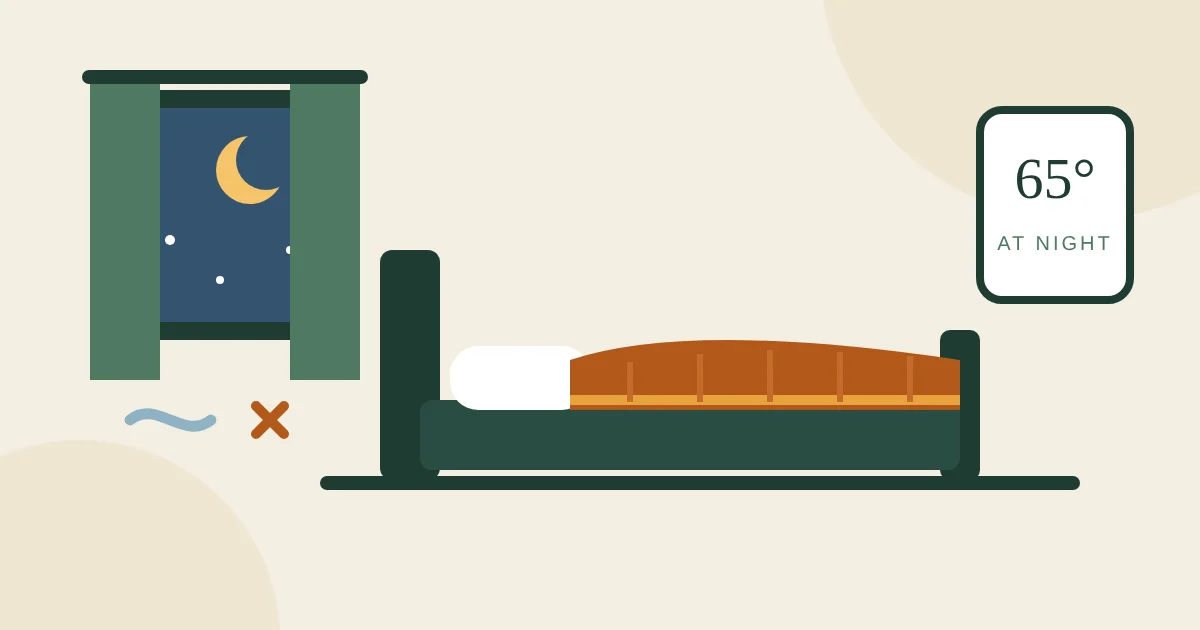
Start the warm-up about 30 minutes before you get up or get home; most programmable thermostats have an “early start” setting that does this for you. If a 60°F bedroom sounds grim, warm the bed instead of the room: a heated mattress pad costs pennies a night (see heated blanket vs space heater), and the Sleep Foundation puts the best temperature for sleep around 65°F anyway.
How low is too low
- 55°F is the floor when you are away. The American Red Cross advises keeping the heat on at no lower than 55°F in cold weather so pipes do not freeze. Pipes on outside walls need extra care during a hard freeze; see how to keep pipes from freezing.
- Skip the deep setback on the coldest nights if you have pipes on outside walls or in unheated spaces.
- Keep it warmer for people who need it: babies, older relatives and anyone with a health condition affected by cold. Comfort and health come before the saving.
Make it automatic
A setback you have to remember every night will not last a winter. A thermostat that runs a schedule makes it automatic. You do not need an expensive smart model: the job is simply to switch between two temperatures on time. Here are three that cover most homes; for a deeper comparison of smart models, our sister site reviewed the best smart thermostats.
I haven’t owned these exact models; the picks are based on the makers’ specifications, compatibility notes and owner feedback.
Amazon Smart Thermostat
The simplest way to get a schedule plus phone control. You set home, away and sleep schedules in the Alexa app, and it is built on Honeywell Home thermostat technology. Amazon notes that many homes need a C-wire (a constant 24-volt power wire) or an adapter, so run its compatibility check before you buy, especially in an older home. It does not have a speaker or microphone; voice control works through an Echo or the Alexa app.
- Home, away and sleep schedules in the Alexa app
- Remote control from your phone
- Made with Honeywell Home thermostat technology
- Check compatibility first: many homes need a C-wire or adapter; 2.4 GHz Wi-Fi
Good: easy schedules, phone control, sold and shipped by Amazon.
Watch out: needs Wi-Fi and the Alexa app; a C-wire adapter adds a step for some homes.
Skip it if: you have electric baseboard heat (it is a low-voltage thermostat) or simply want buttons on the wall.
Honeywell Home X2P Programmable Thermostat
If you want the saving without Wi-Fi, apps or accounts, a basic programmable thermostat does the job. This one runs a 5-2 schedule (one program for weekdays, one for the weekend), has a large backlit screen and runs on two AA batteries, so no C-wire is needed. Honeywell lists it for single-stage systems: 1 heat/1 cool, forced air (gas, oil or electric), hot water heat and 750 mV systems.
- 5-2 day scheduling, or non-programmable mode
- Battery powered (2 AA, not included), no C-wire required
- Extended 32°F low-heat setpoint, backlit display
- 1 heat/1 cool; not for electric baseboard heat (120–240 V); 1-year warranty
Good: cheap, no Wi-Fi or account, works in older homes without a C-wire.
Watch out: single-stage only, so it is not for heat pumps with backup heat; only one weekday program.
Skip it if: you have a heat pump or multi-stage system: choose a model made for it.
Honeywell Home RLV4305A 5-2 Day Programmable Thermostat
Electric baseboard heaters run on 240 volts and need a line-voltage thermostat; the low-voltage models above will not work. This Honeywell programmable model is made for baseboards, convectors, fan-forced heaters and radiant ceilings. It has four program periods a day (wake, leave, arrive and sleep), separate weekday and weekend programs, and silent switching, so there is no clicking at night. Line-voltage wiring is dangerous: turn off the breaker, and hire an electrician if you are not sure.
- For 240 V electric baseboards, convectors and fan-forced heaters
- 5-2 day programming, 4 periods per day
- Up to 3,500 W at 240 V (maker’s spec)
- Silent switching, backlit display
Good: puts a real schedule on the most expensive kind of heat, one room at a time.
Watch out: one thermostat per heater circuit; line-voltage work needs care or an electrician.
Skip it if: your baseboards are 120 V or hydronic (hot water): check the label first.
Mistakes to avoid
- Copying a furnace schedule onto a heat pump. Big setbacks can call for backup heat. Hold steady or keep it small.
- Cranking it up to warm faster. It just overshoots. Set the normal temperature and wait.
- Setbacks of an hour or two. They save little; the long night and workday setbacks are where the money is.
- Going below 55°F when away in freezing weather. A burst pipe costs more than a winter of heat.
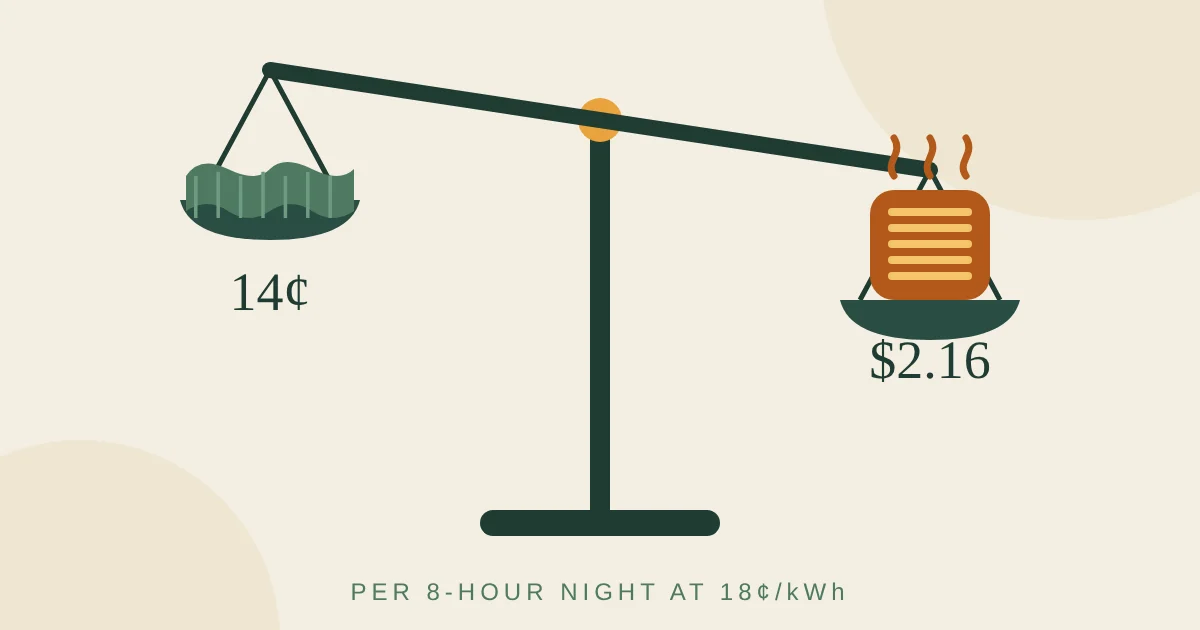
- Turning the heat off, then plugging in space heaters. A 1,500-watt heater costs about 27¢ an hour at the U.S. average rate; see what a space heater costs to run.
FAQ
Does turning down the thermostat at night really save money?
Yes, for furnaces, boilers and baseboard heat. A cooler house loses heat more slowly, so you buy less fuel overnight than the morning warm-up costs. The Department of Energy says setting the thermostat 7 to 10 degrees lower for 8 hours a day can save as much as 10% a year on heating.
Is it cheaper to keep the heat at one temperature all day?
Not with a furnace, boiler or electric baseboard heat. The idea that the system has to work so hard to reheat the house that it wipes out the saving is a myth: the energy you save while the house is cooler is larger than the extra energy needed to warm it back up. Heat pumps are the exception, because a big warm-up can switch on expensive backup heat.
How much should I turn my thermostat down at night?
With a furnace or boiler, 7 to 10 degrees for about 8 hours is the range the Department of Energy uses, for example from 68 degrees to 60 degrees. If that is too cold to sleep, a heated mattress pad or extra blankets make it comfortable. With a heat pump, keep any setback small (a couple of degrees) or hold a steady temperature.
Should I turn my heat pump down at night?
Usually not. Efficiency Maine advises that heat pumps work most efficiently holding a steady temperature and that turning them down overnight will not save money. Ducted heat pumps with electric backup heat are the riskiest, because a big morning warm-up can switch on the backup strips, which cost far more to run.
What is the lowest temperature I can set when I leave the house in winter?
Don't go below 55 degrees. The American Red Cross advises keeping the heat on at no lower than 55 degrees when you are away during cold weather, so pipes do not freeze.
Do I need a smart thermostat to save money?
No. Any thermostat that runs a schedule does the job, including a basic programmable model. A smart thermostat helps if your schedule changes a lot, if you forget to set it, or if you have a heat pump and want a model that warms up gradually.
Keep going
- 20 ways to lower your heating bill this winter
- Heated mattress pad problems: what fails and how to avoid it
- How to keep a cold bedroom warm at night
- Heated blanket vs space heater: which is cheaper to run
- Energy cost calculator
Sources
- U.S. Department of Energy: Six simple steps to save energy and money this winter
- U.S. EIA: Winter Fuels Outlook 2026–27 (October 2026)
- Efficiency Maine: Enhance comfort and savings using your heat pumps
- American Red Cross: How to prevent and thaw frozen pipes
- Sleep Foundation: Best temperature for sleep
Affiliate Disclosure: The Low Bill Home is a participant in the Amazon Services LLC Associates Program. As an Amazon Associate we earn from qualifying purchases, at no extra cost to you. Product details and availability change, so check the listing before you buy.