A burst pipe is the most expensive thing winter can do to a house, and it usually happens to people who did not see it coming: a hose still attached to the outdoor faucet, a kitchen sink on an outside wall, a weekend away with the heat turned right down. Almost all of it is preventable with a few free habits and a handful of cheap parts. Do them before the first hard freeze, not during it.
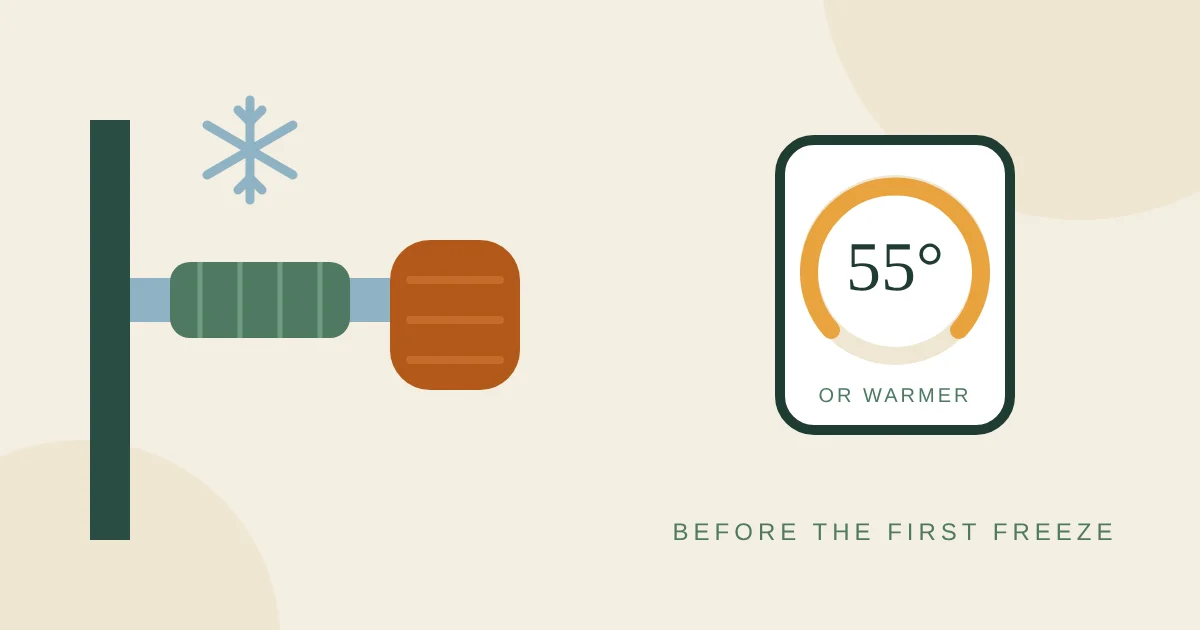
Before the first freeze, disconnect hoses, close the inside valve to each outdoor faucet, drain it and put on a faucet cover. Insulate pipes in crawl spaces, garages and attics with foam pipe covers. On cold nights, open the cabinet doors under sinks on outside walls and let the cold tap drip. Leaving home? Keep the heat at 55°F or higher, as the Red Cross advises. For pipes that freeze every year, add a thermostat-controlled heat cable.
Affiliate note: As an Amazon Associate, The Low Bill Home earns from qualifying purchases. Buying through our links costs you nothing extra. We have not tested every product hands-on: picks are based on the makers' published specs, official energy-saving guidance and long-term buyer feedback, and we say where a product falls short.
Insulated, waterproof covers that strap over outdoor faucets.
Check price on AmazonWhy we picked it ↓Pre-slit foam sleeves for 1/2 to 3/4-inch pipes.
Check price on AmazonWhy we picked it ↓6 ft cable with a built-in thermostat that turns it on when it is cold.
Check price on AmazonWhy we picked it ↓Shopping on Black Friday? Add it to your Amazon cart now so it is ready when the deals start (Black Friday is November 27, Cyber Monday November 30, 2026).
Where pipes freeze
Pipes in the heated middle of a house rarely freeze. The trouble is always at the edges: anywhere cold air reaches the pipe and the house’s heat does not.
10 steps before the first hard freeze
Free (do these this weekend)
- Find your main water shutoff valve and make sure it turns. If a pipe bursts, this is the first thing you need, and you will not want to be looking for it in the dark. N.C. Cooperative Extension recommends knowing where it is and how to use it before winter.
- Disconnect and drain garden hoses. A hose left on traps water in the faucet.
- Close the indoor valve to each outdoor faucet, then open the outdoor faucet to let it drain, and leave it open. The Red Cross explains that this lets any water left inside expand without breaking the pipe.
- Keep the garage door closed if water lines run through the garage.
Cheap (an afternoon)
- Cover outdoor faucets with an insulated cover once they are drained.
- Insulate exposed pipes in crawl spaces, unheated basements, garages and attics with foam pipe sleeves; wrap elbows and valves with insulation tape.
- Seal air leaks around pipes where they pass through outside walls and floors. Cold air on a pipe is what freezes it.
On very cold nights
- Open the cabinet doors under kitchen and bathroom sinks on outside walls so warm air reaches the pipes.
- Let the cold water drip from faucets served by exposed pipes.
- Keep the heat steady. This is the one night to skip the deep thermostat setback; never let the house drop below 55°F.
Saving on heat? A setback of 7–10°F overnight is still a good habit most of the winter (see 20 ways to lower your heating bill). Just keep a floor of 55°F, and skip the setback during a hard freeze if you have pipes on outside walls.
What to buy
We have not tested these products in our own home. Picks are based on the makers’ published specifications, safety certifications and patterns in long-term buyer feedback, especially the complaints.
Outdoor Faucet Covers for Winter (2-pack)
Soft insulated covers that slide over the faucet and fasten with hook-and-loop straps around the pipe. The outer layer is a water-resistant coated fabric, so rain and snow do not soak the insulation. At 6.7 by 8.3 inches they fit most hose bibs and spigots. The 2-pack covers the front and back of a typical house.
- 2 covers, 6.7″ W x 8.3″ H
- Hook-and-loop straps, no tools
- Water-resistant coated outer fabric
- Reusable every winter
Good: fast to fit, fits most faucets, stores flat in summer.
Watch out: a cover does not replace draining the faucet and closing the inside valve.
Skip it if: you have a frost-free sillcock and a heated wall behind it: a cover is optional there.
Frost King FC2 Faucet Cover
The classic hard plastic dome with foam inside that hooks around the faucet with a loop. It shrugs off wind, rain and the lawnmower, and it fits both regular and standpipe outdoor faucets. It is sold one per pack, in dark red.
- Hard plastic shell, insulated inside
- Single cover
- For regular and standpipe outdoor faucets
- Loop fastener, no tools
Good: durable, sheds water, a long-time hardware-store standard.
Watch out: bulkier than a sock; one per pack.
Skip it if: your faucet sits close to a corner or trim: a soft cover fits tighter spaces.
Duck Brand Foam Pipe Covers
Pre-slit foam sleeves that snap over 1/2 to 3/4-inch pipes with self-sealing edges, for the exposed runs in a crawl space, garage or basement, or under a sink on an outside wall. Duck lists an R-value of 3.6. The same sleeves stop cold pipes sweating in summer.
- Pre-slit, self-sealing foam sleeves
- Fits 1/2″ to 3/4″ pipes
- R-value 3.6 (maker’s spec)
- Hot or cold water lines
Good: cheap, no tools, slows heat loss from pipes immediately.
Watch out: insulation slows freezing but cannot stop it in a long hard freeze in an unheated space: add heat cable there.
Skip it if: the pipes are bigger than 3/4 inch: buy sleeves sized to the pipe.
Frost King IT30/8 Rubber Insulation Tape
Straight foam sleeves do not cover elbows, tees and valves well, and those joints are often where pipes freeze first. This 2-inch-wide rubber insulation tape wraps around anything, overlapping as you go. A 30-foot roll covers all the awkward spots in a typical crawl space.
- Rubber insulation tape
- 2″ wide x 1/8″ thick x 30 ft
- For hot and cold water pipes
- Wraps fittings and valves
Good: covers the awkward joints sleeves miss.
Watch out: thin on its own; use sleeves on straight runs.
Skip it if: your pipes are all straight runs: sleeves are quicker.
Frost King HC6A Automatic Electric Heat Cable (6 ft)
When a pipe in a crawl space or an outside wall freezes every winter, insulation alone is not enough. A heat cable runs along the pipe under the insulation and warms it. This one has a built-in thermostat, so it switches on only when it is cold. Frost King rates it for metal and plastic water pipes and says it keeps water flowing down to −40°F. Buy the length of the pipe you need to protect; Frost King sells longer versions.
- 6 ft, 120 V, 7 watts per foot (about 42 W)
- Built-in automatic thermostat
- For metal and plastic water pipes
- Maker’s rating: to −40°F
Good: fixes the problem pipe for good, costs little to run.
Watch out: needs an outlet nearby; follow the instructions exactly (no overlapping, use a GFCI outlet).
Skip it if: the pipe is easy to insulate and the space stays above freezing.
GoveeLife WiFi Thermometer with Alerts
A frozen pipe does not announce itself until it bursts. A small wireless sensor in the crawl space, the sink cabinet or a vacation home sends an alert to your phone when the temperature drops below the limit you set. Govee sells this as a refrigerator thermometer, but the sensor works anywhere within range of the gateway: phone, email and an 80 dB buzzer alert, and one gateway handles up to ten sensors.
- Sensor + WiFi gateway
- App, email and buzzer alerts
- Up to 10 sensors per gateway, range up to about 230 ft (maker’s spec)
- Accuracy ±0.9°F (maker’s spec)
Good: warns you before a pipe freezes, great for second homes and rentals.
Watch out: needs WiFi and power at the gateway; set the alert at about 40°F to give yourself time.
Skip it if: you are always home and the at-risk pipes are easy to check.
Worried about a leak you would not see? Our sister site compares the best water leak detectors.
What a heat cable costs to run
The Frost King HC6A draws about 42 watts (6 feet at 7 watts per foot). At 18¢ per kWh, close to the 2026 U.S. average residential rate:
| If it runs | Energy | Cost |
|---|---|---|
| 1 hour | 0.042 kWh | about 0.8¢ |
| A full 24-hour day | 1 kWh | about 18¢ |
| Around the clock for 30 days | 30 kWh | about $5.44 |
Because the thermostat turns it on only in the cold, a real winter costs less than the worst case above. Compare that with the cost of a single burst pipe.
Going away? A checklist
- Thermostat set no lower than 55°F, as the American Red Cross advises.
- Cabinet doors under sinks on outside walls left open.
- Outdoor faucets drained, inside valves closed, covers on.
- A temperature alert in the coldest spot, or a neighbor who checks the house daily.
- For a long trip in a hard climate, consider shutting off the main valve and draining the lines.
If a pipe freezes
A faucet that only trickles on a very cold morning is a warning. Act before the ice spreads.
- Keep the faucet open. Running water helps melt the ice and relieves pressure.
- Warm the frozen section gently with a hair dryer, a heating pad or towels soaked in warm water, working from the faucet back toward the frozen spot.
- Never use an open flame. The Red Cross warns against a blowtorch, kerosene or propane heater, charcoal stove or any open flame device.
- Check the other faucets. If one pipe froze, others may have too.
- Burst pipe or cannot find the ice? Shut off the main valve and call a plumber.
Safety: water and electricity do not mix. N.C. Cooperative Extension warns about the risk of electric shock when thawing pipes; keep cords and hair dryers away from standing water.
FAQ
At what temperature do pipes freeze?
Water freezes at 32°F, but pipes inside a heated house usually freeze only during a sustained hard freeze, when the outdoor temperature stays well below freezing for hours. The risk is highest for pipes in unheated spaces, on outside walls and where cold air leaks in.
Should I let my faucets drip to keep pipes from freezing?
Yes, during very cold weather, for faucets served by exposed pipes or pipes on outside walls. The American Red Cross advises letting the cold water drip. Moving water is harder to freeze, and an open tap relieves the pressure that builds up when ice forms, which is what actually bursts pipes.
What temperature should I leave my house at to keep pipes from freezing?
The American Red Cross says to leave the heat on and set it no lower than 55°F if you go away during cold weather. Open the cabinet doors under sinks on outside walls so that heat reaches the pipes.
Do faucet covers really work?
They help, as part of a routine. A cover keeps wind off the faucet and holds in a little heat from the house. On its own it will not save a faucet that still has water in the pipe behind it: disconnect the hose, close the shutoff valve inside, and drain the faucet first.
Is heat tape safe?
Used as directed, yes. Use a listed product made for water pipes, follow the maker’s instructions exactly, plug it into a GFCI-protected outlet, and do not overlap or wrap it over itself unless the instructions say it is self-regulating and allow that. N.C. Cooperative Extension recommends using only UL-approved heat tape or cable.
What should I do if a pipe is already frozen?
Keep the faucet open, then apply gentle heat to the frozen section with a hair dryer, a heating pad or towels soaked in warm water, starting near the faucet and working back. The Red Cross says never use a blowtorch, kerosene or propane heater, charcoal stove or any other open flame. If you cannot reach the frozen spot or find it, or if the pipe has burst, shut off the main water valve and call a plumber.
Keep going
- 20 ways to lower your heating bill this winter
- Best weather stripping for doors
- How to stop window and door drafts
- Water heater blanket: is it worth it? (and which pipes to insulate)
Sources
Affiliate Disclosure: The Low Bill Home is a participant in the Amazon Services LLC Associates Program. As an Amazon Associate we earn from qualifying purchases, at no extra cost to you. Product details and availability change, so check the listing before you buy.