Space heater vs central heat calculator
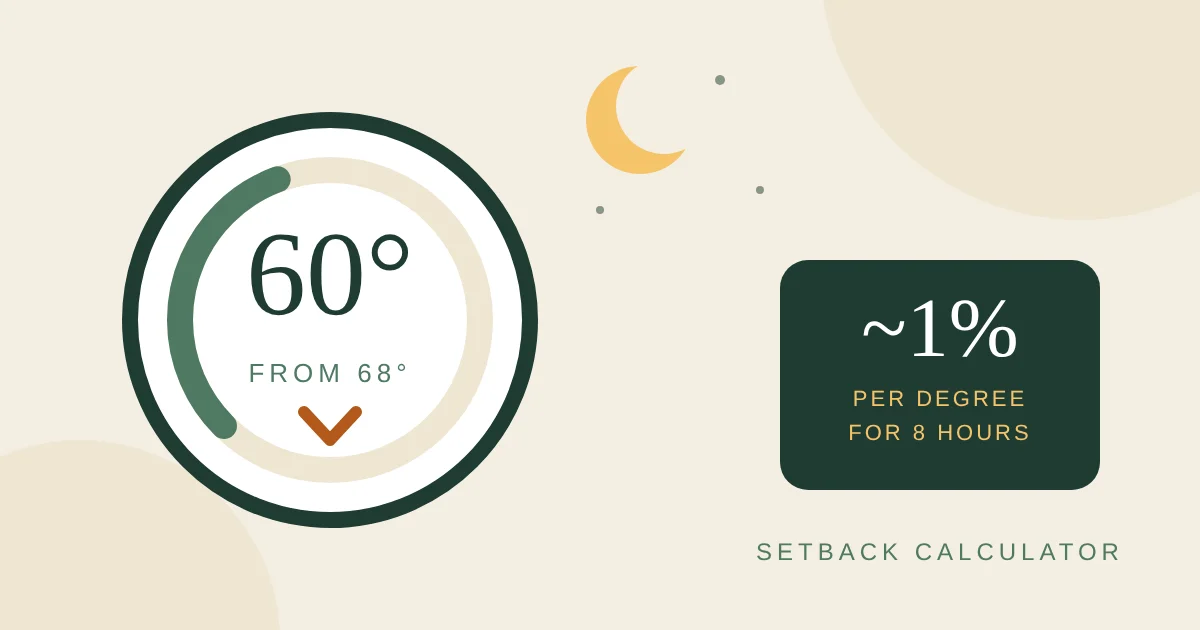
How it works: the Department of Energy’s rule of thumb (a 7–10°F setback for 8 hours a day saves up to 10% a year) works out to roughly 1% of heating cost per degree held for 8 hours. We apply it to your winter heating cost, cap it at 15% and spread it over 5 months. The heater cost assumes 30 days a month. “Share of the time it runs” is 100% for a heater that never switches off; a heater with a thermostat in a small, sealed room may run half the time or less. The defaults are EIA’s forecast U.S. averages for winter 2026–27; your own bills are better.
Affiliate note: As an Amazon Associate, The Low Bill Home earns from qualifying purchases. Buying through our links costs you nothing extra. We have not tested every product hands-on: picks are based on the makers' published specs, official energy-saving guidance and long-term buyer feedback, and we say where a product falls short.
The short answer
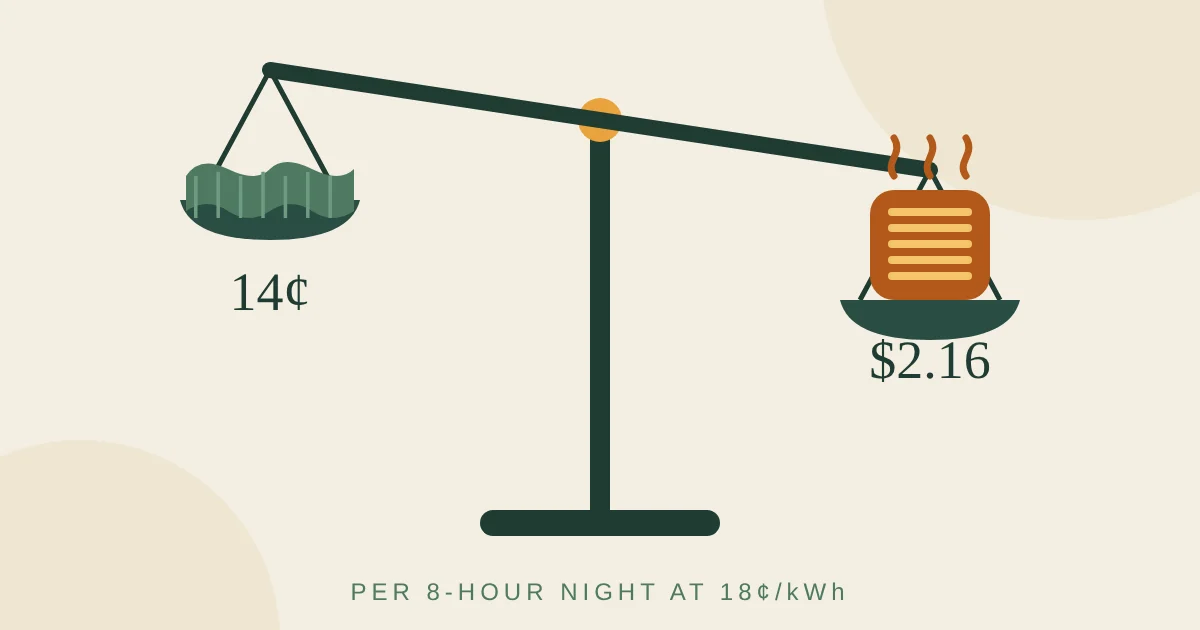
With a gas furnace, a space heater on high usually costs more than it saves. At this winter’s U.S. averages, turning the rest of the house down 8°F for 8 hours a day saves about $10 a month on gas. Running a 1,500-watt heater for those same 8 hours costs about $65 a month at 18¢ per kWh. Even if its thermostat cuts the run time in half, the heater still loses.
What does win almost everywhere is warming yourself instead of the room. A 100-watt heated throw costs about $4 a month for the same 8 hours, so you keep most of the saving.
What it comes to for each fuel
Net result per month for turning the house down 8°F for 8 hours a day, using EIA’s forecast average winter heating costs and 18¢ per kWh. A minus sign means you pay more than you save.
| Main heating | Saved on central heat | Space heater on high, nonstop | Space heater on low | Heated throw |
|---|---|---|---|---|
| Natural gas | $10.24 | −$54.56 | −$22.16 | +$5.92 |
| Electric (furnace or baseboard) | $19.14 | −$45.66 | −$13.26 | +$14.82 |
| Propane | $19.94 | −$44.86 | −$12.46 | +$15.62 |
| Heating oil | $33.84 | −$30.96 | +$1.44 | +$29.52 |
Heater costs: 1,500 W for 8 hours, 30 days = $64.80; 750 W = $32.40; a 100 W throw = $4.32. A heater that cycles on its thermostat costs less than these figures, which is why the calculator lets you set the share of time it runs.
When a space heater does pay off
- You turn the house down a lot, for a long time. A home office heated all workday while the rest of the house sits 10°F cooler saves far more than a bedroom heated for an hour.
- The room is small and sealed. A closed door and a draft stopper let the heater’s thermostat switch it off most of the time. See our guide to stopping window and door drafts.
- Your main heat is expensive. Heating oil, propane and electric baseboard cost more per unit of heat than gas, so the saving on central heat is bigger.
- You use low or eco mode. Running at 750 W or letting the thermostat cycle cuts the heater’s cost in half or more.
If the central thermostat stays where it was, a space heater is pure extra cost. Our guide to what a space heater costs to run compares the cost per unit of heat for gas, heat pumps and electric heaters.
Heat pump homes
A heat pump moves heat instead of making it, so it delivers about 2 to 4 units of heat for every unit of electricity. A space heater delivers one. That makes a space heater the more expensive way to warm a room in most heat pump homes. Big setbacks can also backfire: a morning warm-up from more than about 2°F lower can switch on the backup strip heat. Our thermostat setback calculator explains the heat pump exception.
What to use instead
To warm yourself: a heated throw on the couch or at the desk. The Sunbeam Royal Ultra Heated Throw has 4 heat settings and a 4-hour auto shut-off; the short timer means it is meant for evenings, not all night. We compare throws and heated mattress pads in heated blanket vs space heater.
If you need the room itself warm: pick a heater with a real thermostat, so it cycles off once the room is warm. The De’Longhi EW7707CM oil-filled radiator is silent and has adjustable power; it is slow to warm up and has no timer. More options in oil-filled radiator vs ceramic heater.
Safety: plug space heaters straight into a wall outlet, never a power strip, extension cord or smart plug, and keep them 3 feet from anything that can burn.
The math behind it
Saved on central heat per month = winter heating cost × (degrees × hours ÷ 8)% ÷ 5 months, capped at 15%.
Heater cost per month = watts ÷ 1,000 × hours × share of time running × 30 days × price per kWh.
Net = saved − heater cost.
Sources: the U.S. Department of Energy’s thermostat guidance and EIA’s Winter Fuels Outlook 2026–27 (October 6, 2026). The 1%-per-degree figure is a rule of thumb; your climate, insulation and how far heat leaks from the warm room into the rest of the house all change the real result.
FAQ
Is it cheaper to run a space heater or central heat?
Usually central heat, especially gas or a heat pump. A space heater only saves when it lets you turn the whole-house thermostat down a lot for many hours while you heat one small room. At U.S. averages, a 1,500 W heater on high for 8 hours costs about $65 a month; turning a gas-heated house down 8°F for those hours saves about $10.
Does heating one room save money?
It can, if the room is small and closed off, the heater runs on a thermostat or low setting, and the rest of the house really is turned down. Warming yourself with a 100 W heated throw saves money in almost every case.
How much does a space heater add to my electric bill?
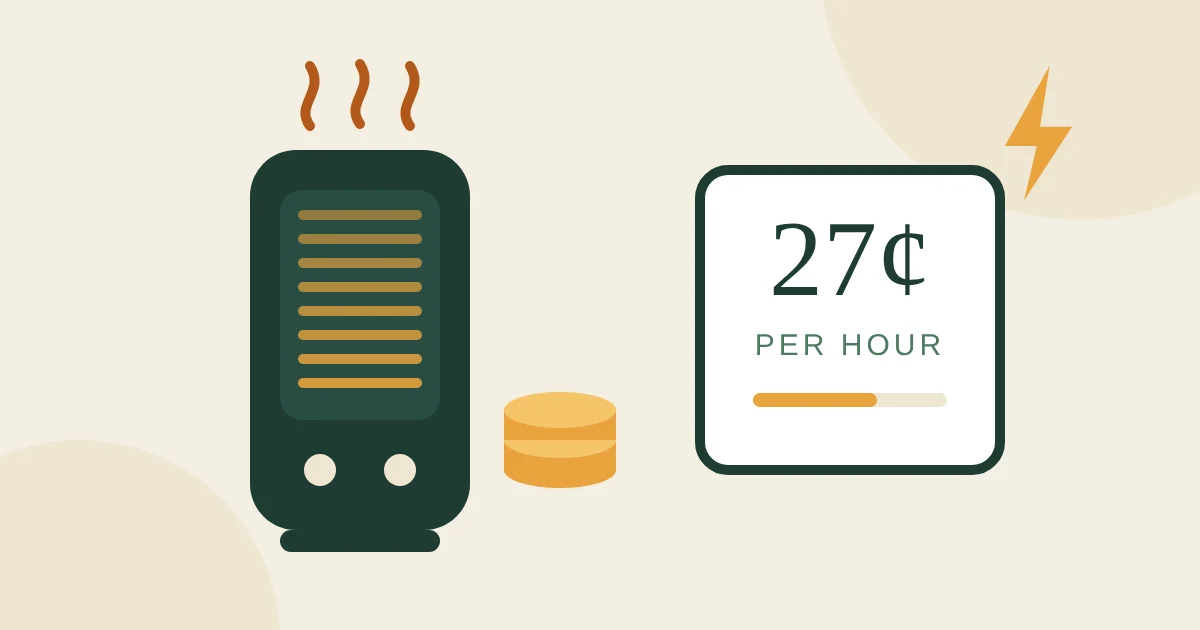
A 1,500 W heater costs about 27 cents an hour at 18 cents per kWh: about $2.16 for 8 hours, or roughly $65 a month if it runs nonstop 8 hours a day. On low (750 W) it is half that.
Should I turn off my heat and use a space heater?
Not completely. Keep the central heat on at a lower setting so pipes do not freeze and the rest of the house does not get damp. In a heat pump home, keep setbacks small, about 2°F.

Email me at hello@thelowbillhome.com. I read every message, and when a rate, a rule or a product changes, I update the guide. — Eugene
Affiliate Disclosure: The Low Bill Home is a participant in the Amazon Services LLC Associates Program. As an Amazon Associate we earn from qualifying purchases, at no extra cost to you. Product details and availability change, so check the listing before you buy.