Walk down any heater aisle and you will see two kinds of portable electric heater: the oil-filled radiator that looks like a small old-fashioned radiator on wheels, and the compact ceramic heater with a fan. Both say “energy saving” on the box. Here is what actually differs, what each one costs to run at your electricity rate, and which one fits which room.
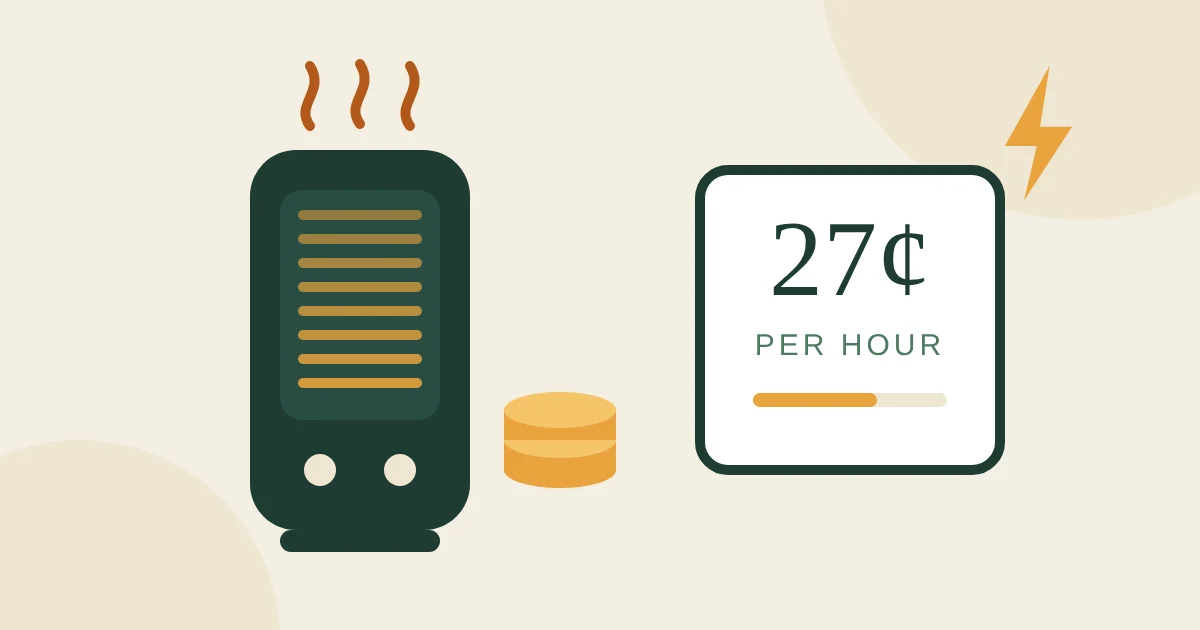
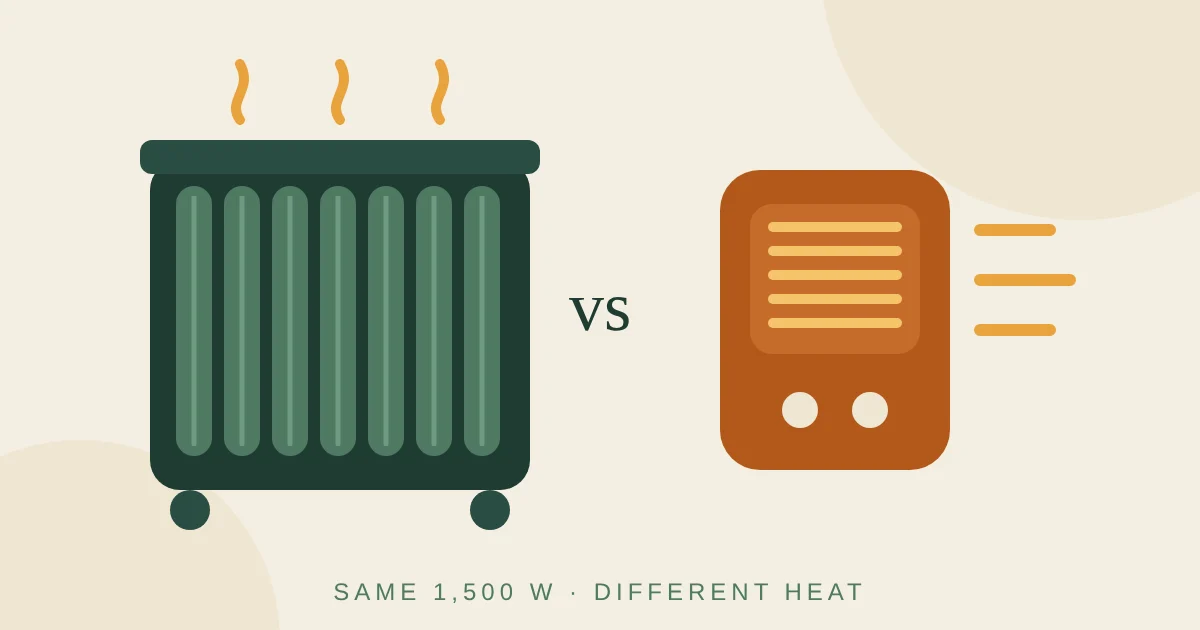
On the same setting they cost exactly the same to run: a 1,500-watt heater of either kind costs about 27¢ an hour at 18¢ per kWh, close to the 2026 U.S. average. The difference is how they heat. A ceramic heater is fast, small and best for short bursts. An oil-filled radiator is slow to start but silent, gentle and keeps radiating after it cycles off, which makes it better for a room you sit in for hours, often on a lower setting. Our picks: the De’Longhi EW7707CM oil-filled radiator and the DREO ceramic heater.
Affiliate note: As an Amazon Associate, The Low Bill Home earns from qualifying purchases. Buying through our links costs you nothing extra. We have not tested every product hands-on: picks are based on the makers' published specs, official energy-saving guidance and long-term buyer feedback, and we say where a product falls short.
The classic oil-filled radiator: silent, wheels, adjustable power and an anti-freeze setting.
Check price on AmazonWhy we picked it ↓Fast heat, a precise 41–95°F thermostat in 1° steps and a quiet 34 dB fan.
Check price on AmazonWhy we picked it ↓Three settings, 600, 900 and 1,500 W, with a thermostat and tip-over protection.
Check price on AmazonWhy we picked it ↓Shopping on Black Friday? Add it to your Amazon cart now so it is ready when the deals start (Black Friday is November 27, Cyber Monday November 30, 2026).
Oil-filled vs ceramic at a glance
| Oil-filled radiator | Ceramic heater | |
|---|---|---|
| How it heats | An element warms sealed oil, which warms metal fins; heat radiates and rises gently | A fan blows air across a hot ceramic element |
| Warm-up | Slow: you feel it after about 15–30 minutes | Fast: warm air within a minute |
| After it switches off | Keeps giving off heat for a while | Stops almost at once |
| Noise | Silent (occasional ticking as it warms) | Fan noise, quiet on good models |
| Air and dust | No fan, so it does not blow dust around | Moves air, spreads heat quickly |
| Size and weight | Bulky and heavy; wheels help | Small and light |
| Typical power settings | 600 / 900 / 1,500 W | About 750–900 W low, 1,500 W high |
| Cost per hour on 1,500 W | About 27¢ | About 27¢ |
| Best for | Home office, living room, warming a bedroom before bed | Quick warm-ups, garage workbench, under a desk for an hour |
What each setting costs
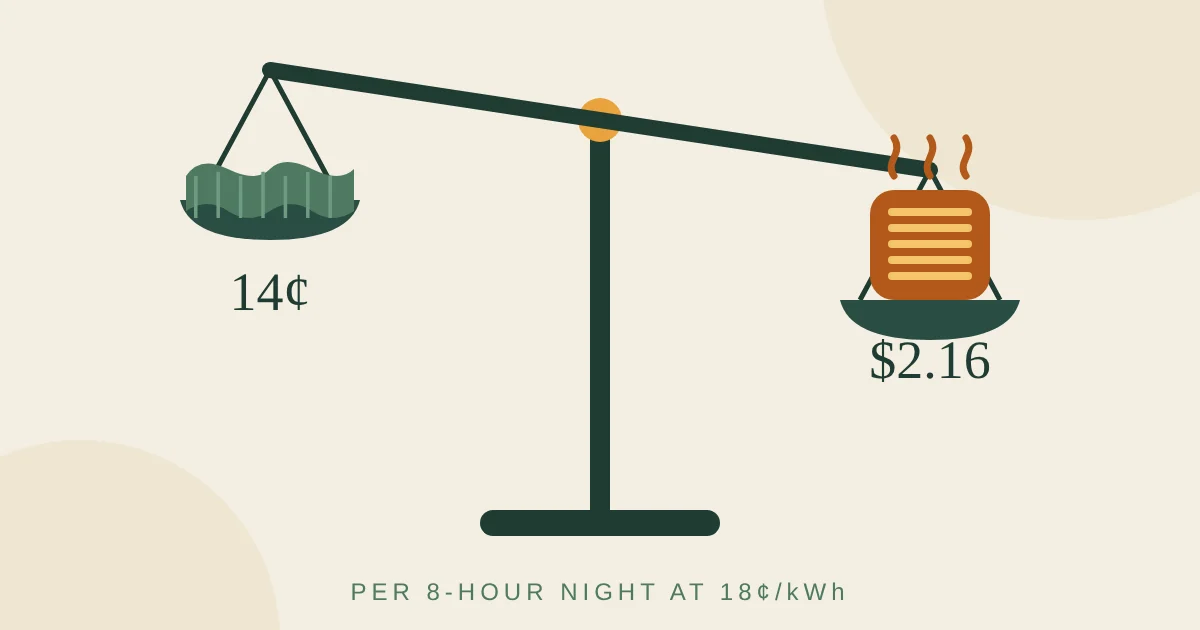
Cost depends only on watts, hours and your rate, not on whether the heat comes from oil or ceramic. At 18¢ per kWh, running at full power on that setting:
| Setting | Watts | Per hour | Per 6-hour evening | Per month (30 evenings) |
|---|---|---|---|---|
| Oil-filled, low | 600 | 10.8¢ | 65¢ | $19.44 |
| Oil-filled, medium / ceramic, low | 900 | 16.2¢ | 97¢ | $29.16 |
| Either type, high | 1,500 | 27¢ | $1.62 | $48.60 |
So why do oil-filled radiators have a reputation for being cheaper? Two real reasons. First, many owners run them on 600 or 900 watts with the thermostat, because steady radiant heat feels comfortable at a lower setting. Second, the hot oil keeps heating the room while the element is off, which smooths out the on-off cycling. Neither changes the cost of a kilowatt-hour; they change how many kilowatt-hours you use. Ignore any box that promises a heater “cuts your bill in half”: a portable heater only saves money when it lets you turn the whole-house thermostat down, as we explain in what a space heater costs to run.
Calculator: your rate, your hours
Pick two heaters and settings, enter your hours and the rate from your bill (total dollars divided by kWh used). To compare states, see EIA’s average price by state.
Heater cost calculator: compare two settings
Option A
Option B
| Cost | Option A | Option B |
|---|---|---|
| Per hour | – | – |
| Per day | – | – |
| Per month | – | – |
| Per season | – | – |
–
Full-power figures: the most each setting can cost. With a thermostat, either heater switches its element off once the room is warm, so real costs are lower. The rate starts at 18¢, close to EIA’s 2026 U.S. average.
Which heater for which room
| Room and use | Better choice | Why |
|---|---|---|
| Home office, several hours a day | Oil-filled | Silent, steady heat on 600–900 W with the thermostat |
| Living room in the evening | Oil-filled | Gentle heat, no fan noise during TV or conversation |
| Bedroom, warming it before bed | Oil-filled | Keeps radiating after you switch it off at bedtime |
| Cold room you use for 30–60 minutes | Ceramic | Warm air in a minute; no waiting for oil to heat |
| Under a desk or in a small cubicle | Ceramic (compact) | Small, aimable, quick |
| Garage workbench (dry, no fuel or fumes nearby) | Ceramic | Fast spot heat; follow the maker’s rules for garages |
| Bathroom | Neither, unless the maker says it is rated for it | Most portable heaters warn against damp rooms |
| Whole house | Neither | Central heat is cheaper per unit of heat; see the link above |
How we chose
- Safety first. Every pick lists tip-over or overheat protection and a safety listing (ETL or equivalent) from the maker.
- A real thermostat. A heater without one simply runs flat out, which is what makes heaters expensive.
- Track record. Established brands with a long sales history and a very large volume of buyer feedback; we passed over brand-new listings.
- The complaints. We read the negative feedback for patterns, such as slow warm-up, ticking noises, controls that reset after a power cut, and say so below.
We have not tested these products in our own home. Picks are based on the makers’ published specifications, safety certifications and patterns in long-term buyer feedback, especially the complaints.
The picks
Oil-filled radiators
De’Longhi Oil-Filled Radiator Heater (EW7707CM)
De’Longhi has made oil-filled radiators for decades, and this is its long-running best seller. Simple dials set the power level and temperature, and its ComfortTemp mode automatically picks the setting to hold a comfortable room temperature; De’Longhi says that uses up to 20% less energy than running the same heater with its thermostat at maximum. The fins are designed to keep the surface temperature lower than older radiators, the elements are fully enclosed, and there is a thermal cut-off. An anti-freeze setting switches it on automatically if the room drops below 41°F, handy for a cold sunroom or basement corner. Snap-on wheels and a handle make it easy to move.
- 1,500 W maximum, adjustable power and thermostat
- ComfortTemp automatic mode (maker claims up to 20% savings vs thermostat at max)
- Anti-freeze setting below 41°F
- Thermal cut-off, enclosed elements, wheels
Good: silent, gentle heat, simple controls, long track record.
Watch out: slow to warm up like all oil radiators; heavy; mechanical dials, no remote or timer.
Skip it if: you want a remote and a digital thermostat: see the DREO.
DREO Oil-Filled Radiator Heater
The modern take: a digital thermostat with a large LED display, touch controls and a remote, four modes including Eco, three power levels (600, 900 and 1,500 watts) and a 24-hour timer, so you can have the home office warm before you start work. It is ETL listed, with tip-over and overheat protection, a child lock and a mute option for the beeps. Big wheels make it easy to roll between rooms.
- 600 / 900 / 1,500 W plus Eco mode
- Digital thermostat, remote, 24-hour timer
- Child lock, tip-over and overheat protection; ETL listed
- 7 fins, wheels and handle
Good: precise digital control, timer to pre-heat a room, remote.
Watch out: more electronics than the De’Longhi; like any oil radiator it needs time to heat up.
Skip it if: you prefer simple dials that never need resetting.
Amazon Basics Portable Oil-Filled Heater
A no-frills oil-filled radiator with the settings that matter: high (1,500 W), medium (900 W) and low (600 W), an adjustable thermostat, tip-over and overheat protection and an ETL listing. The oil is permanently sealed, so there is nothing to maintain. It is a sensible choice for a bedroom or a small office where you want silent heat and do not need a remote.
- 600 / 900 / 1,500 W
- Adjustable thermostat
- Tip-over and overheat protection; ETL listed
- 7 fins, sealed oil
Good: three real power levels, silent, inexpensive for an oil radiator.
Watch out: basic dial thermostat; no timer, remote or anti-freeze mode.
Skip it if: you want to pre-heat the room on a timer.
Ceramic heaters
DREO Space Heater (1,500 W ceramic)
One of the most popular ceramic heaters on Amazon, and a good one: heat within seconds, a thermostat you can set anywhere from 41 to 95°F in 1-degree steps, and a brushless fan rated at 34 decibels, quiet enough for a bedroom while you get ready for bed. Tilt detection for tip-over protection, overheat protection and flame-retardant housing are ETL certified. A remote and a 12-hour timer are included.
- 1,500 W PTC ceramic
- Thermostat 41–95°F in 1° steps
- 34 dB brushless fan (maker spec)
- Tip-over (tilt sensor) and overheat protection; ETL certified; remote, 12-hour timer
Good: fast, precise thermostat, quiet for a fan heater, compact.
Watch out: heat stops as soon as it cycles off; fan heaters dry the air a little more.
Skip it if: you want silent heat for hours at a time: choose an oil-filled radiator.
Lasko 751320 Ceramic Tower Heater
A 23-inch tower with wide oscillation that spreads heat across a medium room rather than just one spot. Two heat settings, a remote, a 7-hour timer, a self-regulating ceramic element, overheat protection and a cool-touch housing, and it is ETL listed. Lasko has been making heaters and fans in the U.S. market for over a century, and this model has been on sale for years.
- 1,500 W ceramic, 2 heat settings
- Wide oscillation
- Remote and 7-hour timer
- Overheat protection, cool-touch housing; ETL listed
Good: spreads heat across the room, easy remote, long track record.
Watch out: only two heat settings and a simpler thermostat than the DREO.
Skip it if: you only need heat at one desk: a compact heater is enough.
Amazon Basics Ceramic Space Heater
A small, light (about 3 pounds) ceramic heater with high (1,500 W), low (900 W) and fan-only settings, tip-over and overheat protection and a thermostat. It is the simple, inexpensive answer for warming your feet under a desk or taking the chill off a small room. Amazon notes it is not for humid rooms such as bathrooms or laundry rooms.
- 1,500 W high / 900 W low / fan only
- Adjustable thermostat
- Tip-over and overheat protection
- About 3 lb, 9.5″ tall
Good: cheap, tiny, quick to heat a small space.
Watch out: no oscillation, remote or timer; basic thermostat.
Skip it if: you need to heat a medium room evenly.
Want more options, including heaters for large rooms? Our sister site compared the best space heaters.
How to spend less with either one
- Turn the central thermostat down. A portable heater only saves money if it lets you heat one room while the rest of the house sits cooler. The Department of Energy says setting back the thermostat 7–10°F for 8 hours a day can save up to 10% a year on heating.
- Use the thermostat, not continuous high. Start on high to warm the room, then let the thermostat (or the 600–900 W setting) hold it.
- Close the door and stop the drafts. A heater cannot keep up with cold air sliding under the door; see the best door draft stoppers.
- Warm yourself, not the room, when you sit still. A heated throw uses about 100 watts; see heated blanket vs space heater.
- Time it. Start an oil-filled radiator 20–30 minutes before you need the room (a timer helps) and switch it off a little early: the oil keeps giving heat.
Safety
The rules are the same for both types. The Consumer Product Safety Commission estimates portable heaters are involved in about 1,700 fires a year (CPSC). Keep heaters at least 3 feet from curtains, bedding, furniture and papers; plug them directly into a wall outlet, never an extension cord, power strip or smart plug; choose models with tip-over and overheat shutoff; and turn them off when you leave the room or go to sleep (CPSC winter safety tips).
FAQ
Is an oil-filled radiator cheaper to run than a space heater?
Not per hour at the same setting. Every electric heater turns electricity into heat at close to 100% efficiency, so a 1,500-watt oil-filled radiator and a 1,500-watt ceramic heater cost the same per hour on high: about 27 cents at 18 cents per kWh. An oil-filled radiator can cost less in practice when you run it on its 600 or 900-watt setting with the thermostat, because the warm oil keeps giving off heat while the element is off.
Which is better for a bedroom, an oil heater or a ceramic heater?
For warming a bedroom before bed, an oil-filled radiator is quieter and keeps radiating heat for a while after you switch it off. The Consumer Product Safety Commission advises turning space heaters off when you go to sleep, whatever the type, so warm the room first, then switch off and rely on bedding.
How long does an oil-filled radiator take to heat a room?
Longer than a ceramic heater: the oil has to warm up first, which typically takes around 15 to 30 minutes before you feel much difference. Switch it on before you need the room, or use a model with a timer.
Do oil-filled heaters need to be refilled?
No. The oil is permanently sealed inside the fins and is never topped up or changed. If a radiator ever leaks oil, stop using it.
Are oil-filled radiators safer than ceramic heaters?
Both kinds can be used safely, and both get hot. Oil-filled radiators have no exposed glowing element and no fan, and ceramic heaters usually have cooler cases. Whatever you buy, choose one with tip-over and overheat protection and a UL or ETL listing, keep it 3 feet from anything that can burn, and plug it straight into a wall outlet.
Can I use an oil-filled radiator all day in a home office?
That is one of the best uses for one: steady, silent heat on a low setting with the thermostat. Turn it off when you leave the room, keep it 3 feet from the desk, papers and curtains, and plug it directly into the wall.
Keep going
- How much does it cost to run a space heater?
- Heated blanket vs space heater: which is cheaper to run
- How to keep a cold bedroom warm at night
- 20 ways to lower your heating bill this winter
Sources
Affiliate Disclosure: The Low Bill Home is a participant in the Amazon Services LLC Associates Program. As an Amazon Associate we earn from qualifying purchases, at no extra cost to you. Product details and availability change, so check the listing before you buy.