The heater runs for twenty minutes, the room is finally getting warm, and then everything goes dark: the TV, the lamp, the heater. You reset the breaker and twenty minutes later it happens again. A space heater tripping the breaker is one of the most common winter complaints, and in most homes the fix is free. Here is how to tell an overloaded circuit from a real problem, a checker that adds up your circuit, and what to do about each cause.
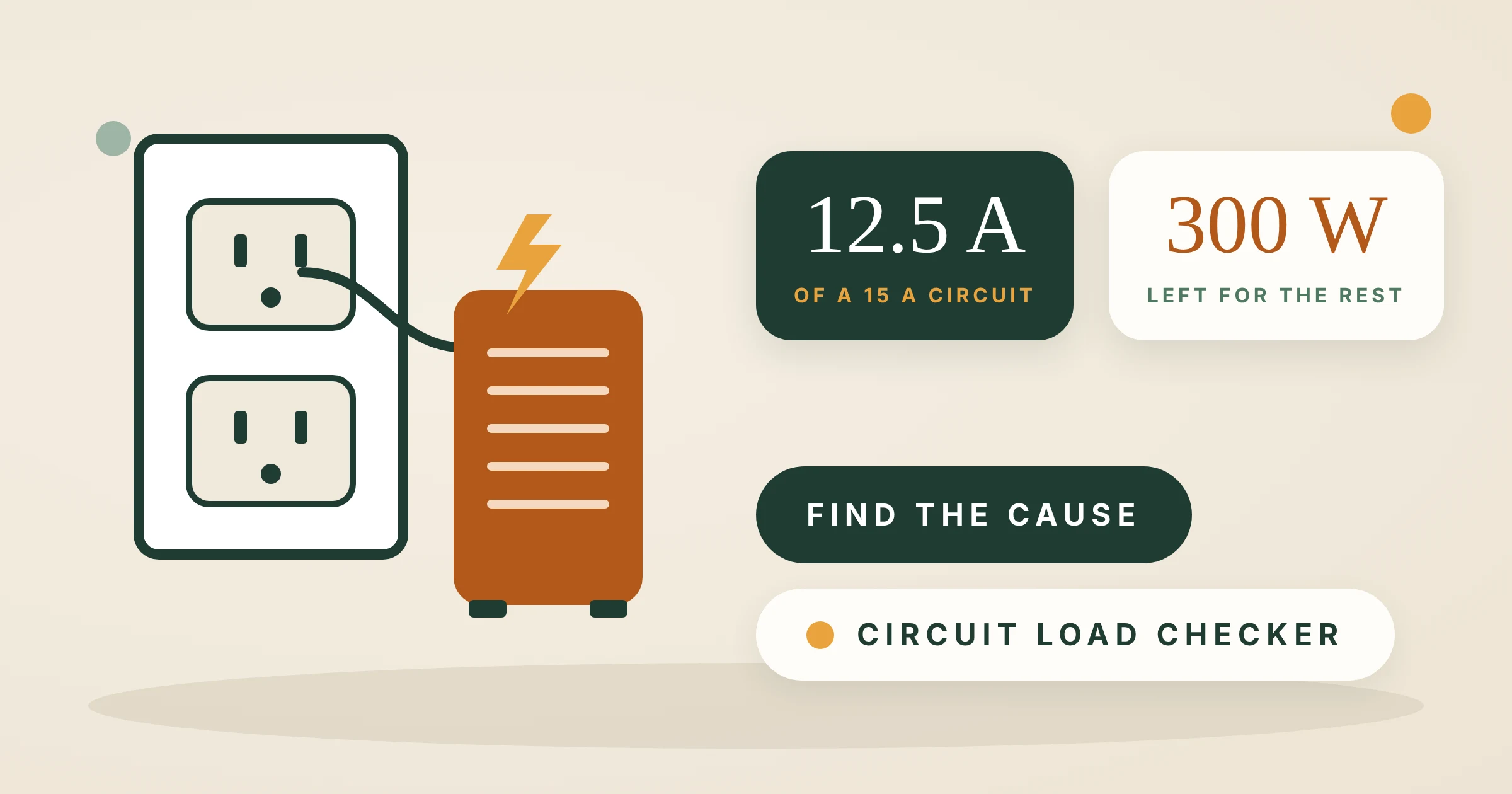
A 1,500-watt heater uses 12.5 of the 15 amps on a typical bedroom circuit. That leaves about 300 watts for everything else on the same breaker, which often includes outlets in the next room. Add a TV, a computer or a vacuum and the breaker trips. Fix it by running the heater on its low setting (900 or 750 W), unplugging other big loads, or using an outlet on another circuit, always straight into the wall, never a power strip. If the heater trips the breaker instantly, or the plug or outlet gets hot or discolored, stop using it and call an electrician.
Affiliate note: As an Amazon Associate, The Low Bill Home earns from qualifying purchases. Buying through our links costs you nothing extra. I have not tested these products hands-on: picks are based on the makers’ specs, warranty terms and owner feedback, and I say where a product falls short.
Shows what the heater and everything else actually draw, in watts and amps.
Check price on AmazonWhy we picked it ↓Spots wiring faults and makes mapping a circuit a one-person job.
Check price on AmazonWhy we picked it ↓600, 900 or 1,500 W: as little as 5 amps, silent and steady.
Check price on AmazonWhy we picked it ↓Shopping on Black Friday? These are small, cheap items, so waiting for a deal saves little. If you want to wait anyway, add them to your cart now (Black Friday is November 27, Cyber Monday November 30, 2026).
Why a heater trips the breaker
A space heater is the biggest thing most people ever plug into a bedroom outlet. Almost all portable electric heaters top out at 1,500 watts, and at 120 volts that is 12.5 amps. Most bedrooms, living rooms and home offices are on 15-amp circuits (1,800 watts), and one circuit usually feeds several outlets and the lights, sometimes across two rooms.
Electricians size circuits so a load that runs three hours or more stays at about 80% of the breaker: 12 amps on a 15-amp circuit. A heater on high is already above that line on its own. Breakers also trip on time: a small overload can take many minutes to trip, a big one trips in seconds. That is why the classic pattern is “fine for half an hour, then everything goes off”, or “trips the moment someone runs the vacuum”.
I’ve done seven rental renovations, and I’ll say this plainly: a breaker that trips is doing its job. The goal is not to stop it tripping at any cost. It is to find out which of the causes below you have, and fix that one.
Circuit load checker
Pick your breaker size and heater setting, tick what else runs on the same circuit at the same time, and the checker shows the total load and whether it will hold.
Will this circuit hold my space heater?
Amps = watts ÷ 120 volts. Device wattages are typical values; check the label or measure with a plug-in meter. The 80% line is the electrician’s sizing rule for loads that run three hours or more, like a heater.
Six causes and how to tell them apart
| What you notice | Most likely cause | What to do |
|---|---|---|
| Trips after 10–60 minutes on high, fine on low | Overload: the heater plus other things on the same breaker | Use the checker, unplug the other loads, run the heater on low, or move it to another circuit |
| Trips the moment someone uses the vacuum, hair dryer or microwave | Shared circuit | Find what else is on that breaker (steps below) and keep big loads off it while the heater runs |
| Trips instantly when you switch the heater on, in any outlet in the house | A fault in the heater or its cord | Stop using it. Do not try other outlets “to see”; replace the heater |
| A kitchen, bathroom, garage or outdoor outlet clicks off (the outlet’s own button pops) | GFCI outlet tripping, often from moisture or a cord fault | Do not use heaters in wet areas. If it trips with a dry heater, test the outlet and the heater elsewhere |
| The plug or outlet feels hot, looks brown or melted, or smells | A worn or loose outlet (or plug) overheating at the contacts | Unplug now and do not use that outlet. Have an electrician replace it. This is the dangerous one |
| Trips with only the heater on low and nothing else | A weak or failing breaker, or a wiring problem | Call an electrician; breakers can wear out after many trips |
When to stop and call an electrician
An overloaded circuit is annoying but simple. These signs are different. The Electrical Safety Foundation International lists them as warnings of an overloaded or failing circuit:
- Flickering, blinking or dimming lights
- Warm or discolored outlet or switch plates
- A burning smell from outlets or switches
- Breakers that trip often or fuses that blow often
- Crackling, sizzling or buzzing from outlets
- A mild shock or tingle from appliances, outlets or switches
If you notice any of these, unplug the heater, do not use that outlet, and have an electrician look at it. The CPSC links portable heaters to about 1,700 fires a year (2017–2019 average), and worn outlets and overloaded cords are part of that picture. Keep the heater 3 feet from anything that can burn, and do not leave it running while you sleep or when you leave the room.
How to find what else is on the circuit
- Reset the breaker properly. A tripped breaker sits in the middle. Push it fully to OFF first, then back to ON. If it trips again right away with everything unplugged, stop and call an electrician.
- Map the circuit. With a lamp or an outlet tester plugged in, switch that breaker off and walk around: every outlet and light that goes dead is on the same circuit. Write it on the panel label. It often includes outlets in the next room or the hallway.
- Add up what runs at the same time. Read the watts on each device’s label, or measure with a plug-in meter, and put them in the checker above.
- Feel the plug after 30 minutes. A heater plug can feel warm. If it is too hot to hold, or the outlet face is discolored, the contacts are worn. Unplug and do not use that outlet again until it is replaced.
- Pick the outlet with the least on it, ideally a circuit with nothing else running, and plug the heater straight into the wall.
Fixes that work
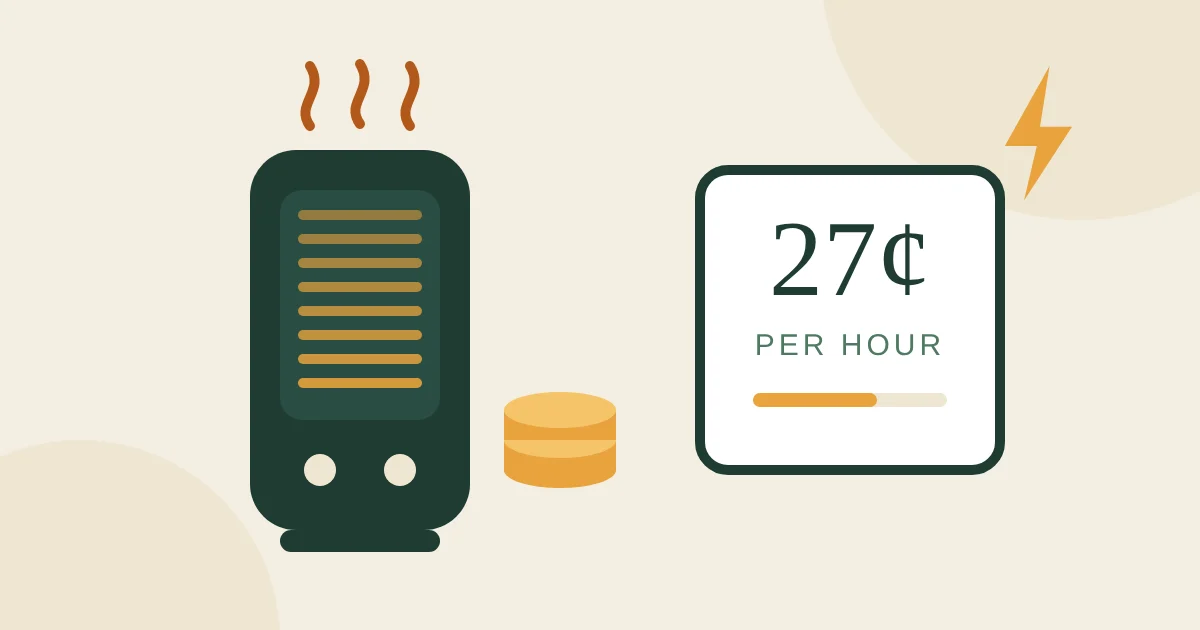
- Run it on low. Most ceramic heaters have a 900 W or 750 W low setting, which draws 6–7.5 amps instead of 12.5. With the thermostat set, a heater on low often keeps a small, closed room at the same temperature, just more slowly, and it costs less per hour: about 16 cents at 900 W versus 27 cents on high at 18 cents per kWh.
- Plug it straight into the wall. The CPSC and ESFI say not to use extension cords or power strips for heaters. A power strip adds outlets, not capacity, and its contacts and cord are often not built for 12.5 amps all evening.
- One heat-producing appliance per outlet. ESFI’s rule: do not run the heater and a kettle, hair dryer or another heater from the same outlet.
- Move it to a different circuit. If the room’s outlets share a breaker with a home office or the TV wall, use an outlet on another breaker that is near the heater, rather than reaching with a cord.
- Heat yourself, not the room. A heated throw uses about 100 W, under 1 amp. On a desk or a sofa it often replaces the heater entirely.
- Ask an electrician for a dedicated circuit if you heat one room every winter. A new 20-amp circuit for a home office or a cold bedroom is a common, affordable job, and it is the real fix for a heater that runs every evening.
- Do not change the breaker for a bigger one. The breaker protects the wire in the wall. A 20-amp breaker on wire made for 15 amps lets the wire overheat inside the wall, where you cannot see it.
How we chose
Every pick does one job from the fix list: measure the real load, check the outlet, heat with fewer amps, or replace the heater with something that draws almost nothing. Three of them we already cover in depth in our heater comparisons; the meter and tester are inexpensive, widely sold tools. We checked that each is in stock for U.S. delivery and compared maker specs and warranty terms. We did not include “heavy-duty” extension cords or power strips: safety agencies say heaters should go straight into the wall.
The picks
P3 Kill A Watt P4400 Electricity Usage Monitor
Labels give the maximum watts; a plug-in meter shows what the heater and everything else on the circuit actually draw, in watts and amps. Plug the heater into it for a few minutes on high and on low, then measure the TV, the PC and the humidifier, and you have real numbers for the checker. It is rated for 15 A / 1,875 VA, enough for a 1,500 W heater, but use it for measuring, then plug the heater straight into the wall again, as the CPSC advises.
- Watts, amps, volts, kWh, power factor, elapsed time
- Accuracy 0.2% (maker’s figure)
- 15 A / 1,875 VA / 125 V maximum
- No app or Wi-Fi
Good: the fastest way to see which device pushes the circuit over.
Watch out: small screen, cycling through modes takes a few presses; not for leaving a heater plugged through it all winter.
Skip it if: you only need the heater’s wattage: it is printed on the label.
Klein Tools RT210 GFCI and Standard Outlet Tester
A plug-in tester shows in a second whether an outlet is wired correctly: open ground, open neutral, reversed polarity and more, with a button to test GFCI outlets. It is also the easiest way to map a circuit: plug it in, flip the breaker, see if the lights go out. Klein says it survives a 6.6-foot drop.
- Detects common wiring faults
- GFCI test button
- Rated for a 6.6 ft drop
- For standard 3-wire 120 V outlets
Good: cheap, fast, makes circuit mapping a one-person job.
Watch out: a plug-in tester cannot see everything (for example a loose connection behind the outlet or some ground faults); a hot or discolored outlet needs an electrician whatever the tester says.
Skip it if: you have two-prong outlets with no ground: the tester cannot help there.
Amazon Basics Ceramic Space Heater (1,500 / 900 W)
If your current heater has only one setting, a small ceramic heater with a 900 W low and an adjustable thermostat is the simplest fix for a circuit that trips: 7.5 amps on low leaves room for lights and a TV. It has tip-over and overheat protection and weighs about 3 pounds. We compare it with DREO in Amazon Basics vs DREO.
- 1,500 W high / 900 W low / fan only
- Adjustable thermostat
- Tip-over and overheat protection
- About 3 lb
Good: cheap, low setting that fits most busy circuits, sold by Amazon.
Watch out: small fan heater: warms a small room, not a large open space; the thermostat dial is not marked in degrees.
Skip it if: you want quiet, even heat for a bedroom all night: look at the oil-filled radiator below.
De’Longhi Oil-Filled Radiator (EW7707CM, 600 / 900 / 1,500 W)
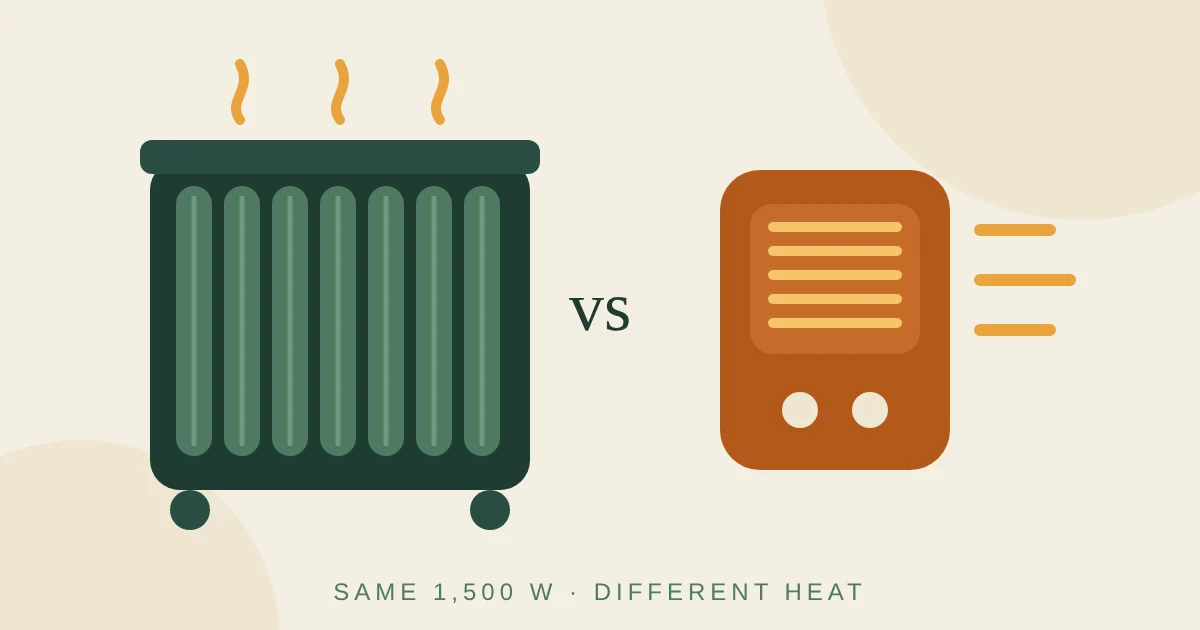
An oil-filled radiator with a 600 W setting draws just 5 amps, and once the oil is hot it keeps radiating heat when the thermostat cycles off. On a circuit that trips at 1,500 W, running it on 600 or 900 W with the thermostat set is often enough for a closed bedroom. It has an anti-freeze setting and a thermal cut-off. See our oil-filled vs ceramic comparison for the trade-offs.
- 600 / 900 / 1,500 W settings
- Adjustable thermostat, anti-freeze below 41°F
- Thermal cut-off
- Silent, no fan
Good: three power levels, silent, steady heat at low amps.
Watch out: slow to warm up (plan on 20–30 minutes); heavy; on 1,500 W it trips a busy circuit just like any other heater.
Skip it if: you need fast heat in a room you use for an hour: a ceramic heater warms you sooner.
Bedsure Heated Throw (50 × 60 in)
At about 100 W, a heated throw uses less than 1 amp, so it never trips anything, and it costs under 2 cents an hour at 18 cents per kWh. For evenings on the sofa or at the desk, it often replaces the space heater. It has six heat levels, a preheat mode and auto-off from 1 to 10 hours.
- About 100 W
- 6 heat levels, preheat
- Auto-off 1–10 hours
- Machine washable; ETL certified
Good: almost no load on the circuit, pennies to run, warms you directly.
Watch out: warms one person, not the room; controller cords wear if pinched in a recliner.
Skip it if: the room itself has to be warm, for example for a baby or an older relative.
Shopping for a small heater? Compare the two cheap best sellers in Lasko 754200 vs Amazon Basics.
FAQ
Why does my space heater keep tripping the breaker?
Usually because the circuit is overloaded. A 1,500-watt heater draws 12.5 amps, and most bedroom and living room circuits are 15 amps shared by several outlets, lights and devices. Add a TV, a computer or a vacuum and the total goes over 15 amps. Run the heater on low, unplug other loads, or use an outlet on another circuit.
Can a 15-amp circuit handle a 1,500-watt space heater?
On its own, yes: 12.5 amps is under 15. But it uses about 83% of the breaker, above the 80% electricians plan for loads that run for hours, and it leaves only about 300 watts for everything else on that circuit. That is why heaters trip breakers on busy circuits.
Is it dangerous if a space heater trips the breaker?
The breaker tripping is the safety system working. The danger signs are different: a plug or outlet that is hot, brown or melted, a burning smell, buzzing, or a heater that trips the breaker the instant you turn it on. In those cases stop using the heater or that outlet and call an electrician.
Can I plug a space heater into a power strip or extension cord?
No. The CPSC and the Electrical Safety Foundation International both say to plug heaters directly into a wall outlet. Power strips and extension cords are often not built for a heater's continuous load and can overheat.
Should I replace the breaker with a 20-amp one?
No. The breaker size matches the wire in the wall. A bigger breaker on wire meant for 15 amps lets the wire overheat inside the wall. If you need more power in a room, have an electrician add a dedicated circuit.
Does running a space heater on low use less electricity?
Yes, per hour. A heater on 900 watts uses 0.9 kWh an hour, about 16 cents at 18 cents per kWh, versus 27 cents on 1,500 watts. With the thermostat set, a heater on high also cycles off, so the real difference depends on the room; but on low it also draws far fewer amps from the circuit.
Keep going
- How much does a space heater cost to run? Calculator for your rate
- Oil-filled radiator vs space heater: which uses less
- Heated blanket vs space heater: the cost difference
- Space heater vs central heat calculator
Sources

Email me at hello@thelowbillhome.com. I read every message, and when a rate, a rule or a product changes, I update the guide. — Eugene
Affiliate Disclosure: The Low Bill Home is a participant in the Amazon Services LLC Associates Program. As an Amazon Associate we earn from qualifying purchases, at no extra cost to you. Product details and availability change, so check the listing before you buy.