The first cold morning, the heat comes on for the first time in months, the house smells of hot dust, and someone remembers the furnace filter. At the store the shelf goes from cheap fiberglass to MERV 13 “allergen” filters that cost several times more. Is the expensive one better, or is it quietly making your system work harder? It depends on your furnace, and it takes 30 seconds to figure out.
For most homes with a standard 1-inch filter slot, a pleated MERV 8 to 11 filter, changed on time, is the best value. Choose MERV 13 if someone has allergies or asthma, you get wildfire smoke, or you have a 4-inch or deeper media cabinet, which keeps airflow up. EPA’s advice for an upgrade is at least MERV 13, or as high as your fan and filter slot can accommodate. If rooms get weaker airflow or the filter whistles after you upgrade, step down. And whatever you buy, a clogged filter costs more than any MERV number.
Affiliate note: As an Amazon Associate, The Low Bill Home earns from qualifying purchases. Buying through our links costs you nothing extra. I haven’t lab-tested filters: this guide is based on EPA guidance, published airflow studies and the makers’ ratings, checked October 30, 2026.
30-second filter picker
Which MERV for your system?
General guidance. Your furnace or air handler manual has the final word on filter type and pressure drop.
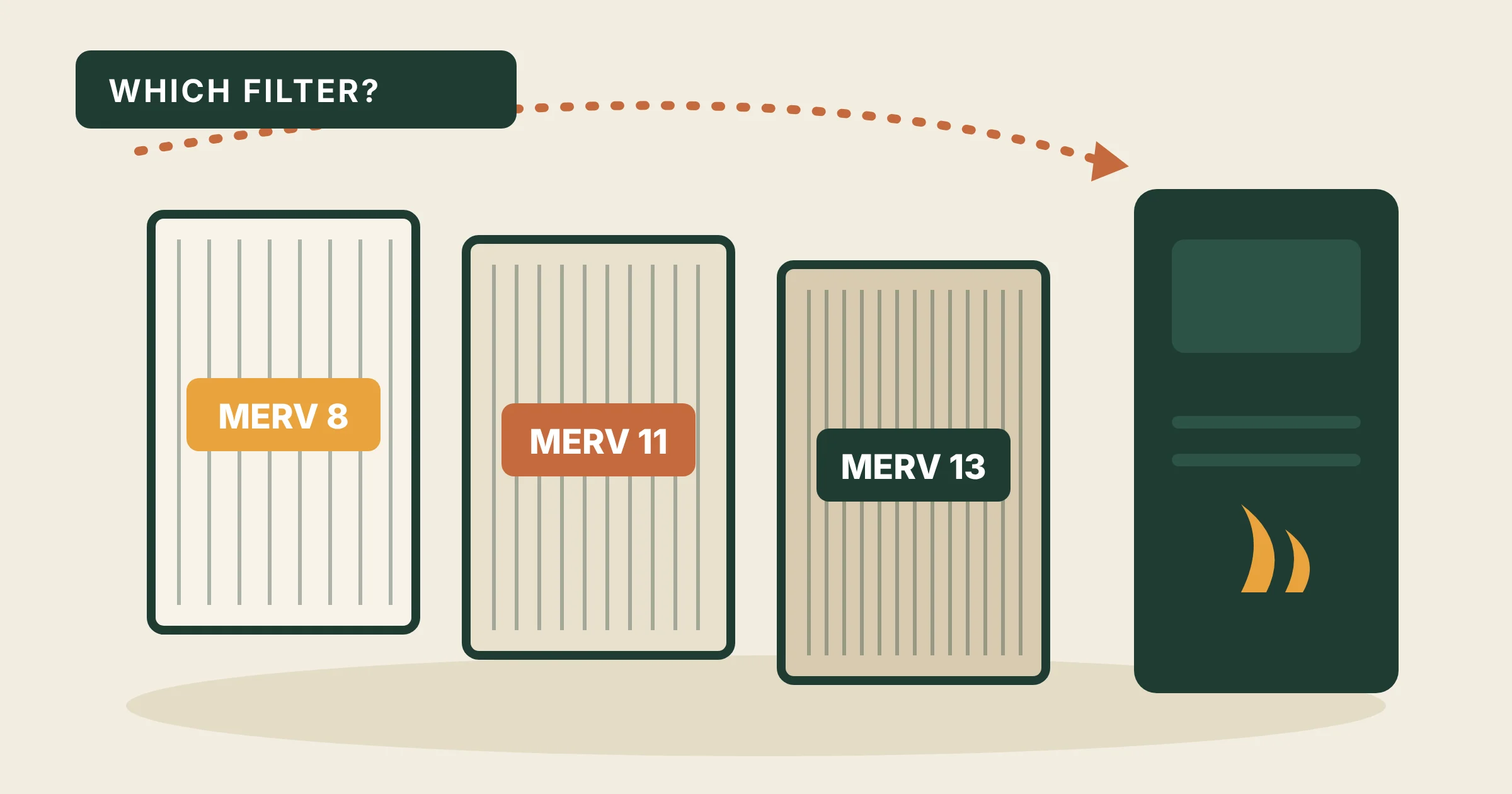
What MERV 8, 11 and 13 catch
MERV (Minimum Efficiency Reporting Value) runs from 1 to 16 and shows how well a filter catches particles of different sizes. Higher catches more of the smallest particles, the kind that get deep into lungs.
| Rating | Catches well | Typical use |
|---|---|---|
| MERV 1–4 (fiberglass) | Lint, large dust | Protects the equipment, not your lungs |
| MERV 8 | Dust, pollen, dust mites, mold spores | Standard pleated filter; safe for almost any system |
| MERV 11 | The above plus pet dander and more fine dust | Pets, mild allergies, on most 1-inch slots |
| MERV 13 | The above plus a large share of smoke and the finest particles | Asthma, wildfire smoke; best in a 4-inch cabinet |
EPA’s advice, if you upgrade, is a filter rated at least MERV 13, or as high as your system fan and filter slot can accommodate, and that the filter should fit snugly without bending. It also says you may need an HVAC technician to tell you the highest your system can handle.
Does a higher MERV raise your bill?
This is where the internet argues, so here is what was actually measured, from a summary of several studies by Green Building Advisor:
- Pressure drop rises, but not evenly. In one study, a low-MERV filter measured 0.10 inches of water column, MERV 8 measured 0.19 and MERV 11 measured 0.32. Design guidelines assume about 0.10, and a California field study of 34 homes averaged 0.28, nearly three times that.
- Single-speed (PSC) blowers lose airflow, not much electricity. In two test systems, high-MERV filters cut airflow by 7% and 11%. Less airflow can make a heat pump or air conditioner run longer to deliver the same heat.
- Variable-speed (ECM) blowers fight back. They speed up to hold airflow, which keeps comfort but can use more electricity when static pressure is high.
- Area matters more than depth. The fix is more filter surface: a 4-inch media filter or a larger grille, so the air moves slowly through it.
My own take from renovating rentals: the filter is one of those things nobody looks at until something goes wrong. A clean MERV 8 or 11 in a 1-inch slot is a sensible default. If you want MERV 13, a 4-inch media cabinet is the way to do it right. And if your heat pump’s air feels weak, check the filter before anything else; the rest of the checklist is in heat pump blowing cold air.
How often to change it
| Filter | Typical interval | Change sooner if |
|---|---|---|
| 1-inch pleated | Check monthly; replace when gray or at the maker’s interval (often up to 90 days) | Pets, smokers, construction dust, heavy heating weeks |
| 2-inch pleated | Usually longer than 1-inch; follow the package | Same |
| 4–5-inch media | Often 6 to 12 months; follow the maker | Visible loading, airflow drop |
A trick that works: write the date on the filter frame with a marker when you put it in, and set a phone reminder for a month later to look at it.
The first-heat burning smell
When the heat runs for the first time in the season, dust that settled on the heat exchanger and burners over the summer burns off. An HVAC technician interviewed by NBC 5 in Dallas–Fort Worth said the burning-dust smell should last only a couple of minutes. A fresh filter helps, because a dirty one adds its own dust.
Turn the system off and call a technician if the smell lasts, if it smells like melting plastic or electrical burning, or if a carbon monoxide alarm sounds. With a gas furnace, a working CO alarm on every sleeping floor is not optional.
Getting the size right
- The size is printed on the side of the old filter, for example 16 × 25 × 1. That’s the nominal size; the actual filter is slightly smaller, which is normal.
- The arrow on the frame points toward the furnace, in the direction of airflow.
- A filter that’s too small lets air bypass it. Don’t bend one to fit.
- Buy a multi-pack: the per-filter cost drops, and a spare in the closet means you actually change it.
Filters worth buying
All three come in dozens of sizes, so the links open the range: choose your exact size. Check that the MERV on the package matches what the picker suggested.
MERV 8 pleated filters (multi-pack)
A standard pleated filter that catches dust, pollen and mold spores with low resistance. The right choice for older single-speed systems and anyone who just wants the furnace protected and the dust down.
- MERV 8
- 1-inch and 2-inch sizes
- Cheapest per month
Filtrete MPR 1000 (MERV 11)
Filtrete’s middle tier, commonly listed as MERV 11: more fine dust and pet dander than a basic pleated filter, and widely available in common 1-inch sizes.
- MPR 1000 = MERV 11
- 1-inch sizes
- Good for pets
MERV 13 filters (Filtrete MPR 1900 or 4-inch media)
The level EPA recommends when the system can handle it. In a 1-inch slot, watch the airflow after the first week; in a 4-inch media cabinet, it’s the best way to clean the air without choking the blower.
- MERV 13
- Best in 4-inch cabinets
- Change on time
Also worth having: a plug-in carbon monoxide alarm if you heat with gas. Trying to bring the whole bill down? Start with how to lower your heating bill this winter and the thermostat setback calculator.
FAQ
Is MERV 13 too restrictive for a home furnace?
Not always, but it can be. In one study cited by Green Building Advisor, a MERV 11 filter had a pressure drop of 0.32 inches of water column versus 0.19 for MERV 8, and high-MERV filters cut airflow by 7 to 11 percent in two test systems. EPA recommends MERV 13 or the highest rating your fan and filter slot can handle.
Does a higher MERV filter raise my energy bill?
On older single-speed (PSC) blowers, a restrictive filter mostly lowers airflow and energy use changes little, but less airflow can make a heat pump or AC work longer. On variable-speed (ECM) blowers the motor speeds up to keep airflow, which can use more electricity. A dirty filter of any MERV is worse than a clean higher-MERV one.
How often should I change a 1-inch furnace filter?
Check it every month during heating season and replace it when it looks gray or at the maker's interval, which is often up to 90 days for 1-inch pleated filters. Homes with pets, smokers or construction dust need more frequent changes.
What MERV is best for pet hair and allergies?
MERV 11 is a common middle ground for pet dander and pollen on a typical 1-inch slot. MERV 13 catches more fine particles, including smoke, and is what EPA recommends if your system can handle it, ideally in a 4-inch media cabinet.
Why does my furnace smell like burning the first time I turn it on?
Dust that settled on the heat exchanger and burners over summer burns off. The smell should fade within minutes. If it lasts, smells like melting plastic or electrical burning, or a CO alarm sounds, turn the system off and call a technician.
What do Filtrete MPR ratings mean in MERV?
Filtrete uses its own MPR scale. MPR 1000 is commonly listed as MERV 11, MPR 1500 as MERV 12 and MPR 1900 as MERV 13. Newer Filtrete packages print the MERV rating too.
Sources
- EPA: What is a MERV rating?
- Green Building Advisor: Do high-MERV filters always reduce airflow?
- NBC 5 Dallas-Fort Worth: HVAC technician on first-cold-snap calls and the burning dust smell

Email me at hello@thelowbillhome.com. I read every message, and when a rate, a rule or a product changes, I update the guide. — Eugene
Affiliate Disclosure: The Low Bill Home is a participant in the Amazon Services LLC Associates Program. As an Amazon Associate we earn from qualifying purchases, at no extra cost to you. Product details and availability change, so check the listing before you buy.