A window air conditioner is the best thing in the apartment in July and the worst thing in January. All winter it sits in an open window, held in place by thin plastic side panels, with a metal box full of vents between your warm room and the cold outside. You feel it as a cold draft by the window and a radiator that never seems to catch up. Here is how much heat really leaks out, when to take the unit out, and how to seal it properly when you cannot.
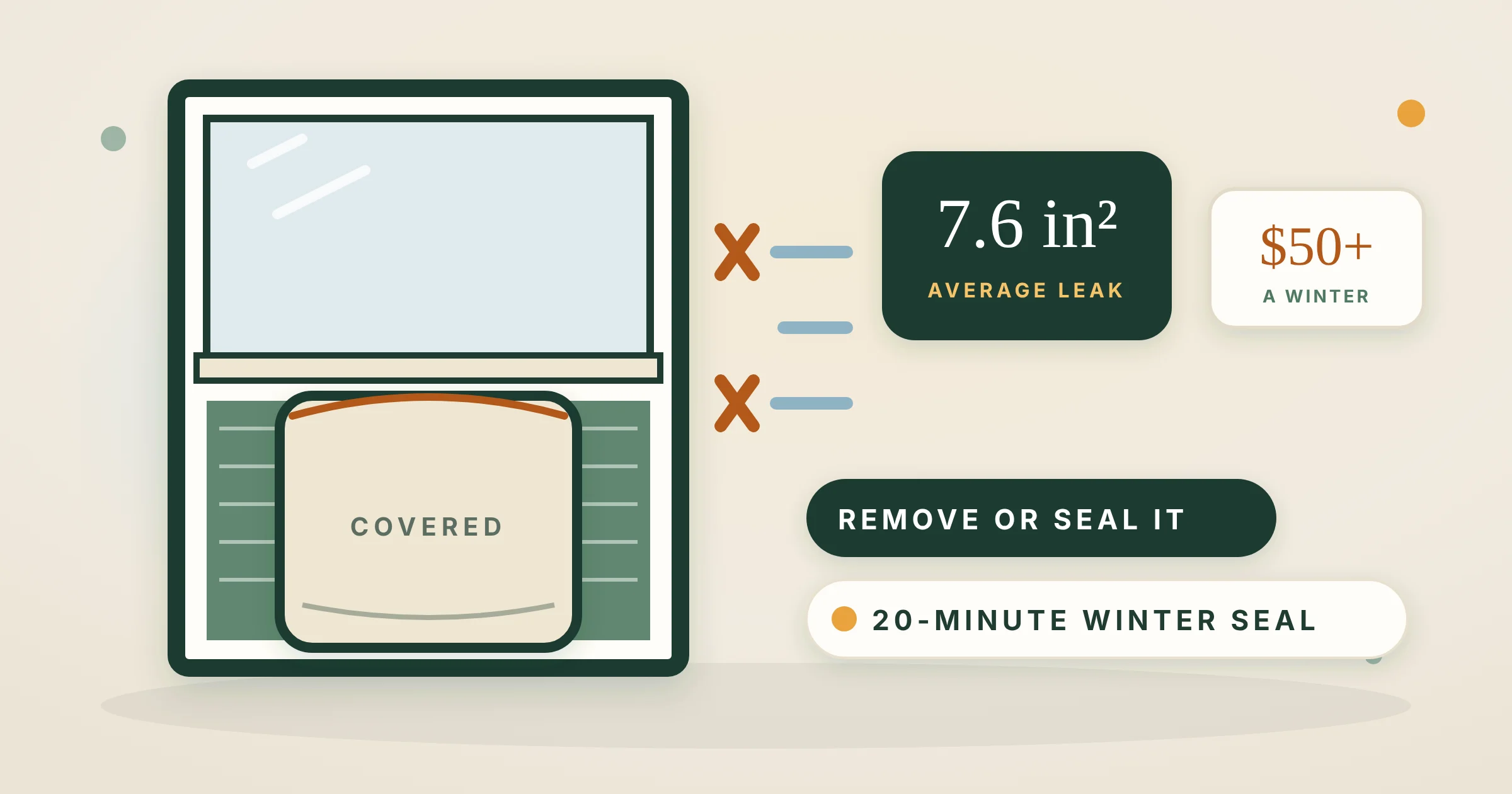
Take it out if you can do it safely: that stops the leak completely. In tests of New York apartments, the Urban Green Council found the average room air conditioner leaks as much air as a 6-square-inch hole, and window units averaged 7.6 square inches. On our estimate, one window unit left in all winter costs about $50–65 of gas heat in a New York–type climate, or about $165–210 with electric baseboard heat. If the unit has to stay, seal it in layers: an outdoor cover where you can reach it safely, foam over the side panels, foam tape in the gap between the window sashes, and a snug indoor cover. Our picks: COSFLY indoor cover, Frost King AC2H outdoor cover and Breeze Stop surround panels.
Affiliate note: As an Amazon Associate, The Low Bill Home earns from qualifying purchases. Buying through our links costs you nothing extra. We have not tested these covers hands-on: picks are based on the makers’ published specs and sizes, building-science research and long-term buyer feedback, and we say where a product falls short.
Slips over the front of the unit with an elastic edge, with a cord hole. Two sizes: 21 × 15 and 25 × 16 inches.
Check price on AmazonWhy we picked it ↓Heavy 6-mil polyethylene with an elastic strap, 18 × 27 × 16 inches. Sold by Amazon.
Check price on AmazonWhy we picked it ↓1-inch foam in white vinyl that covers the flimsy accordion panels and the top gap. Cut to fit.
Check price on AmazonWhy we picked it ↓Shopping on Black Friday? Covers are cheap, so there is no reason to wait for a deal: the first cold snap is when the leak starts costing you. If you do want to wait, add them to your cart now (Black Friday is November 27, Cyber Monday November 30, 2026).
Where a window AC leaks in winter
The air conditioner itself is only part of the problem. A window unit is held in a raised window sash with accordion panels on the sides, and every joint in that setup lets air through. These are the four usual leaks, from biggest to smallest in most apartments:
Most people only buy an indoor cover, which handles leak 3 from the inside. The side panels and the gap between the sashes are often bigger, and they are cheap to fix with foam.
What the leak costs
The best measurements come from New York City, where millions of window and through-wall units stay in place all winter. In There Are Holes in Our Walls (2011), the Urban Green Council and Steven Winter Associates measured air leakage around room air conditioners in apartments. They found the average unit leaks like a 6-square-inch hole (window units averaged 7.6, through-wall sleeve units 5.2), and estimated it adds 2.3 to 3.2 million Btu to an apartment’s heating each winter, about $32–45 per unit at 2011 fuel prices. In electrically heated buildings they estimated the cost at two to three times as much.
We updated that to today’s prices for one window unit, and scaled it to other climates by how cold the winter is:
| Climate (example cities) | Gas furnace | Heat pump | Electric baseboard |
|---|---|---|---|
| Mild (Atlanta, Dallas) | about $29 | about $37 | about $92 |
| Moderate (Washington DC, Nashville) | about $42 | about $53 | about $134 |
| New York, Philadelphia, Seattle | about $53 | about $67 | about $167 |
| Cold (Chicago, Boston, Denver) | about $66 | about $84 | about $209 |
| Very cold (Minneapolis, Burlington VT) | about $84 | about $107 | about $267 |
Our estimate, per window unit per winter: 2.5 million Btu of heat for an average unit in New York (within the report’s range), times 7.6/6 for a window unit, scaled by heating degree days. Gas at $1.50 per therm in a 90% furnace, a heat pump at an average efficiency (COP) of 2.5, electricity at 18 cents per kWh. Real leaks vary a lot with how the unit was installed: treat this as a ballpark, not a bill.
Two units in an electrically heated apartment in a cold city can be $400 a winter. That is why the cheapest fix in this guide, foam and a cover, is one of the best returns of any winter upgrade. If your heat is included in the rent, you still pay in comfort: the leak is the cold draft you feel by the window.
Window AC leak calculator
What your air conditioners cost you in heat this winter
Taking the unit out and closing the window saves the full amount. Covers and foam stop part of the leak; how much depends on the fit, so we show half as a middle case. Based on the Urban Green Council’s New York measurements, scaled to your climate.
Remove it or cover it?
The Urban Green Council’s advisory committee recommended removing window units in winter where possible, and covering them where not. Building scientist Martin Holladay gives the same advice: take it out, and if that is difficult or awkward, cut the air leaks with rope caulk, gaskets or window film. Use this to decide:
| Your situation | Best move |
|---|---|
| Small unit, ground or low floor, two people available | Remove it, store it upright, close and lock the window |
| Upper floor, heavy unit, or a bracket screwed into the frame | Winterize in place: indoor cover + foam (outdoor cover only if a pro or a safe balcony can reach it) |
| Through-wall sleeve unit | Cover inside and out; sleeve units are built to stay |
| Your unit also heats (a heat pump window unit) | Do not cover it while you use it for heat; seal the side panels and sash gap only |
| The unit is in a bedroom’s only window | Take it out if you can: building codes require an openable escape window in every bedroom |
How to take it out and store it
Even small window units weigh 35 to 45 pounds, larger ones much more, and they are heavy toward the outside. Do it with two people, on a dry day, and never lean out of an upper-floor window.
- Unplug it and let it sit for a day if it ran recently, so condensate can drain.
- Remove the screws that hold the side panels and any L-brackets to the sash.
- One person holds the unit while the other raises the sash a little. Tilt the unit toward you and lift it straight back into the room.
- Drain and dry it: tip it gently over a towel or a tub to empty the base pan, then wipe it dry. Wash the filter and let it dry fully.
- Store it upright in a dry place, covered against dust, with the side panels and screws in a bag taped to it.
- Close and lock the window, and check the sill for old foam strips that keep it from closing tight.
Safety: if the unit sits on an exterior bracket above a sidewalk, or you are above the ground floor and it feels heavy, do not wrestle it. Leave it, seal it, or ask the building super or a handyman.
How to winterize it in place: 20 minutes
If the unit stays, work from the outside in. Each layer stops a different leak from the diagram above.
- Unplug it and clean the filter. Thread the plug through the indoor cover’s cord hole later, or tuck it away so nobody turns the unit on under a cover.
- Outdoor cover, only if you can reach it safely from a balcony, fire escape (where allowed) or the ground. It keeps wind, rain and snow out of the cabinet. Pull the strap tight so it does not flap.
- Seal the gap between the sashes (leak 2). Press a strip of 1-inch foam tape into the gap where the raised lower sash overlaps the upper one. This is the leak most people miss.
- Cover the accordion panels (leak 1). Cut rigid foam panels or a surround kit to fit snugly between the unit and the window frame, over the plastic panels. Snug is the point: the foam should press against both sides.
- Close the small cracks (leak 4 and the corners) with rope caulk. It presses in with your fingers and peels off in spring without marks.
- Put on the indoor cover last (leak 3). Pull the elastic tight around the back edge of the front panel, with the cord through the hole.
- Test it. On a windy day, hold a stick of incense or a strip of tissue around the edges. Smoke or tissue that moves means a gap: add foam or caulk there.
If you rent, everything above comes off in spring without screws or residue. Ask before you leave anything permanent, and keep the original side panels: you will need them to reinstall the unit.
How to measure for a cover
- Indoor cover: measure the front face of the unit inside the room, width × height, and how far it sticks out from the window (depth). The cover should be the same size or up to an inch bigger. COSFLY’s 21 × 15 × 3-inch cover fits faces 19–21 inches wide and 13–15 inches tall; the 25 × 16 × 3-inch size fits 23–25 by 14–16.
- Outdoor cover: measure the part outside the window, width × height × depth from the window to the back of the cabinet. Small units fit covers around 21 × 15 × 16 inches (Luxiv lists its 21 × 16 × 15-inch cover for 3,000–7,000 BTU units); bigger units need larger covers such as the Frost King’s 18 × 27 × 16 inches.
- Foam panels: measure from each side of the cabinet to the window frame, and the height of the opening. Buy panels a little bigger and cut them down with a bread knife or scissors.
How we chose
- Clear sizes published by the maker, so you can buy the right one the first time.
- Removable: nothing that needs screws or leaves residue, so renters can use it.
- Materials that hold up to cold: heavy polyethylene, coated fabric, closed-cell neoprene foam.
- Long-term buyer feedback on fit, wind and how the adhesive holds in winter.
- In stock and sold by Amazon or the brand with U.S. delivery when we checked on October 23, 2026.
The picks
COSFLY Indoor Air Conditioner Cover
A simple, well-sized indoor cover is the first thing to buy, because it is the one layer anyone can put on. The COSFLY cover is 210D polyester and cotton that slips over the front of the unit; an elastic edge pulls it in behind the front panel, and a small hole in the lower corner lets the power cord out. It comes in two sizes: 21 × 15 × 3 inches for units with fronts 19–21 inches wide and 13–15 tall, and 25 × 16 × 3 inches for 23–25 by 14–16.
- 210D polyester/cotton, white
- Elastic edge, cord hole
- Sizes: 21 × 15 × 3 in and 25 × 16 × 3 in
- No tools
Good: on in a minute, neat look, keeps dust out of the coil too.
Watch out: fabric slows air but does not stop it; it does nothing for the side panels or the sash gap; only as good as the size you choose.
Skip it if: your unit’s front is larger than 25 × 16 inches: measure and look for a larger cover.
Frost King (Thermwell) AC2H Outdoor Window AC Cover
Frost King has made weatherproofing basics for decades, and this is its standard outdoor cover for window units. It is heavy-duty reinforced 6-mil polyethylene, sized 18 × 27 × 16 inches, with an elastic strap to keep it tight. Frost King says it protects the unit from winter weather and reduces drafts and heat loss. It is shipped and sold by Amazon.
- 6-mil reinforced polyethylene
- 18 × 27 × 16 inches
- Elastic strap
- Shipped and sold by Amazon
Good: inexpensive, waterproof, a trusted weatherproofing brand.
Watch out: plastic gets stiff in deep cold and can tear in strong wind after a season or two; only install it where you can reach safely.
Skip it if: you cannot reach the outside of the unit without leaning out: use indoor layers only.
Luxiv Window AC Unit Cover, Outdoor (21 × 16 × 15 in)
If plastic covers have torn on you before, a coated fabric cover lasts longer. This one is 420D waterproof Oxford cloth with a silver inner layer, sized 21 inches wide, 16 deep and 15 tall, which the maker says fits most standard 3,000–7,000 BTU window units. Two adjustable straps with snap buckles hold it on in wind.
- 420D Oxford fabric, silver lining
- 21 W × 16 D × 15 H inches
- For about 3,000–7,000 BTU units
- Two buckled straps
Good: tougher than plastic, buckles instead of a single elastic, reusable for years.
Watch out: too small for 8,000 BTU and larger units; black fabric fades in sun; still needs safe outside access.
Skip it if: your unit is bigger than about 21 inches wide: the Frost King AC2H is larger.
Breeze Stop Surround Insulation Side Panels
This kit goes after the leaks a cover cannot reach. It is three pieces of 1-inch insulating foam covered in white vinyl: two side panels and one long top panel, with adhesive flaps that attach to the air conditioner, not the window. Together they form a frame around the unit that covers the existing accordion panels (it does not replace them) and the top gap. It fits windows up to 36 inches wide; you cut the panels with scissors so they fit snugly between the unit and the frame.
- 1-inch foam in white vinyl, 3 pieces
- Fits windows up to 36 in wide
- Adhesive flaps attach to the AC only
- Cut to fit with scissors
Good: seals the biggest leaks around the unit, looks tidy, nothing stuck to the window frame.
Watch out: a loose cut leaves gaps, so measure twice; adhesive flaps may need pressing back on in very cold rooms.
Skip it if: you only want to cover the accordion panels: the cheaper LBG panels below do that.
LBG Products Window AC Foam Insulation Panels (2-Pack)
The simplest fix for flimsy accordion panels: two 17 × 9-inch foam panels, 7/8 inch thick, with a pair of self-stick side channels. They cover broken or drafty original panels, or replace them, on most window units from about 5,000 BTU up, according to the seller. The foam also damps noise and vibration in summer.
- 2 foam panels, 17 × 9 × 7/8 inch
- Self-stick side channels included
- Cut to width
- Black
Good: cheap, fixes the weakest part of the install, works summer and winter.
Watch out: 17 inches may not cover a tall opening; does not seal the top gap; black looks heavier than white in a bright room.
Skip it if: you want one kit for the sides and the top: get the Breeze Stop set.
fowong AC Window Seal Foam Tape, 1 × 1 inch, 13 ft
This is the fix for leak 2, the gap between the two window sashes above the unit, and for the strip along the sill. It is closed-cell neoprene foam, 1 inch wide and 1 inch thick, in two 6.5-ft rolls. The thick foam squeezes into wide or uneven gaps, and fowong says its tissue-tape backing sticks to metal, wood and vinyl and removes cleanly, which matters for renters.
- Closed-cell neoprene, 1 × 1 inch
- 2 rolls, 13 ft total
- Sticks to metal, wood, vinyl
- Made for window AC gaps
Good: fills big gaps that thin weatherstrip cannot, repels water, enough for the sash gap and the sill.
Watch out: clean and dry the surface first or it will peel in the cold; 1 inch is too thick for narrow cracks (use rope caulk).
Skip it if: your sash gap is under 1/2 inch: thinner foam or rope caulk fits better.
Frost King B2 Mortite Fingertip Caulking Cord (90 ft)
Rope caulk is the renter’s best friend. Mortite is a soft gray cord you press into cracks with your fingers: around the corners of the side panels, along the sill, between the sash and the frame. It never hardens, so it seals tight all winter and peels off in spring. Frost King says it works on wood, plastic, metal, masonry, glass and concrete. One 90-ft roll does several windows. It is shipped and sold by Amazon.
- 1/8-inch cord, 90 ft
- No caulk gun, press in by hand
- Stays soft, removable
- Indoor and outdoor
Good: cheap, seals odd-shaped cracks, no residue on most painted frames.
Watch out: gray shows on white frames; can leave an oily mark on raw wood; pets and kids like to pick at it.
Skip it if: the gap is wider than a pencil: use foam tape instead.
Mistakes to avoid
- Running the AC under a cover. If anyone might switch it on, unplug it and put the plug where it is not easy to reach.
- Covering a unit you use for heat. Some window units are heat pumps; covering them blocks the airflow they need.
- Only buying an indoor cover. The side panels and the sash gap often leak more than the unit.
- Leaning out to fit an outdoor cover. Skip it rather than risk a fall or dropping something on the street.
- Wrapping the whole unit and window in plastic from inside. It traps condensation against the frame; seal the gaps instead.
- Blocking a bedroom’s only escape window all winter when the unit could come out.
- Throwing away the original side panels. You need them to reinstall the unit in spring.
FAQ
Should I take my window air conditioner out for the winter?
Yes, if you can do it safely. Removing it and closing the window stops the leak completely. The Urban Green Council found window units in New York apartments leak like a hole of about 7.6 square inches on average, and its advisory committee recommended removing them in winter where possible. If the unit is heavy, on an upper floor or bracketed outside, seal it in place instead.
Is it bad to leave a window AC in all winter?
Not for the unit: window air conditioners are built to sit outside. The problem is heat loss and drafts. On our estimate one window unit costs about $50 to $65 of gas heat a winter in New York to Chicago climates, and $165 to $210 with electric baseboard heat. If it stays, seal the side panels and the gap between the sashes, and cover it inside and, where safe, outside.
Do indoor air conditioner covers work?
They help with the air that comes through the unit's own vents, and they stop the cold draft you feel in front of it. They do not touch the leaks around the side panels and between the window sashes, which are often bigger. Use the cover as the last layer, after foam panels and foam tape.
Which is better, an indoor or an outdoor AC cover?
Both work best together. An outdoor cover keeps wind, rain and snow out of the cabinet; an indoor cover stops room air from flowing through the vents. If you can only use one, use the indoor cover: anyone can install it without leaning out of a window.
Should I unplug my window air conditioner in winter?
Yes. Unplug it before you put a cover on, so nobody can switch it on under the cover, and so it draws no standby power. If the unit is also a heat pump that you use for heat, do not cover it.
How do I insulate around a window air conditioner?
Cover the plastic accordion side panels with rigid foam panels cut to fit snugly, press 1-inch foam tape into the gap where the two window sashes meet above the unit, and fill small cracks with rope caulk such as Mortite. All three come off in spring without marks.
Keep going
- How to winterize an apartment: 12 renter-friendly fixes that leave no marks
- Best window insulation kits for the rest of your windows
- How to stop window and door drafts
- How to lower your heating bill this winter
Sources
- Urban Green Council and Steven Winter Associates: There Are Holes in Our Walls (2011, PDF)
- Urban Green Council: A study of the impact of building envelope penetrations on thermal performance
- Green Building Advisor: How much heat is saved removing a window-mounted air conditioner in winter?
- ENERGY STAR: Seal and insulate
- U.S. EIA: Winter Fuels Outlook 2026–27 (October 2026)
- U.S. EIA: Short-Term Energy Outlook, electricity

Email me at hello@thelowbillhome.com. I read every message, and when a rate, a rule or a product changes, I update the guide. — Eugene
Affiliate Disclosure: The Low Bill Home is a participant in the Amazon Services LLC Associates Program. As an Amazon Associate we earn from qualifying purchases, at no extra cost to you. Product details and availability change, so check the listing before you buy.