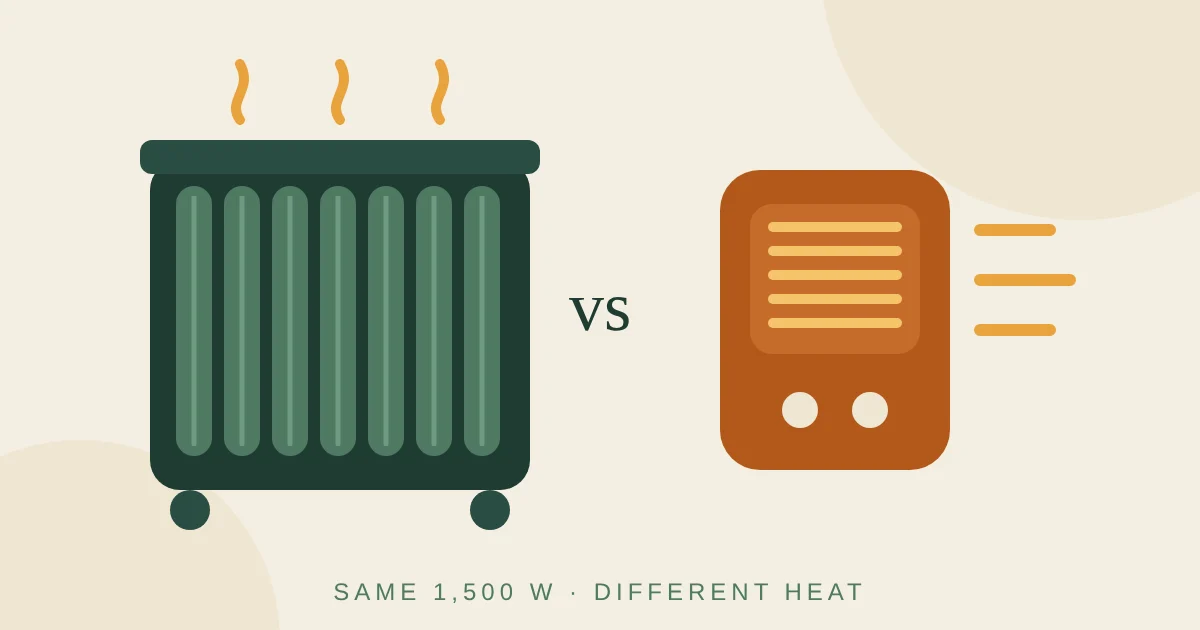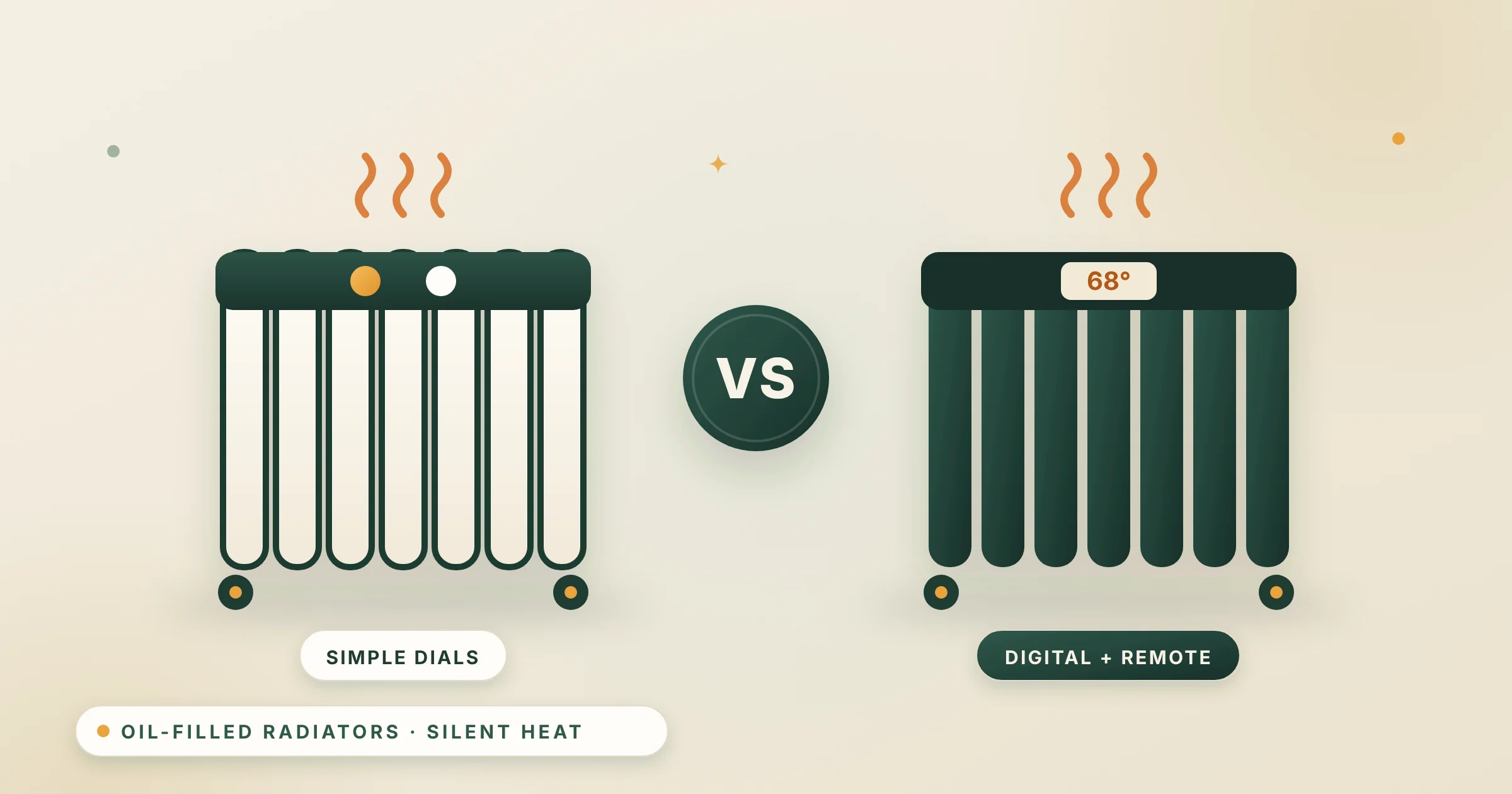
Oil-filled radiators are the quiet, gentle option among electric heaters: no fan, no glow, just warm fins that keep radiating after the element switches off. The two most popular on Amazon take very different approaches. The De’Longhi EW7707CM is the classic, with simple dials and a ComfortTemp energy-saving button. The DREO oil-filled radiator is digital, with a remote, an exact thermostat and a 24-hour timer.
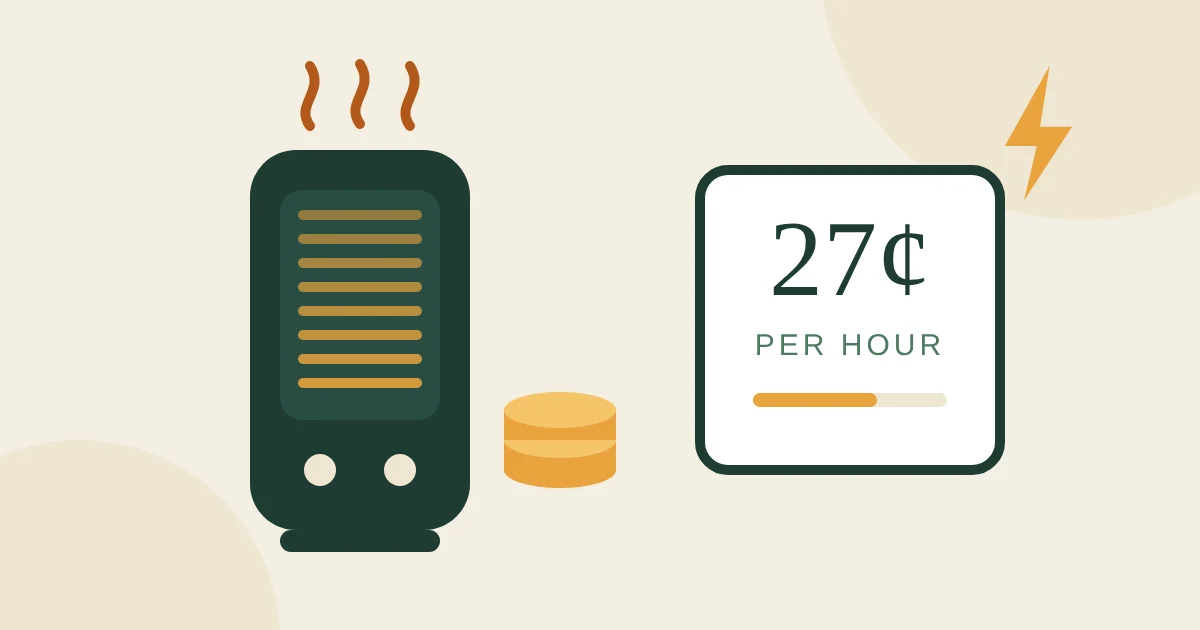
Both run at 600, 900 or 1,500 watts—about 11¢, 16¢ or 27¢ an hour at 18¢ per kWh. Choose the De’Longhi EW7707CM for simple, durable controls, an anti-freeze setting and a 3-year warranty. Choose the DREO oil-filled radiator if you want to set an exact temperature (41–95°F), use a remote and pre-heat the room with a 24-hour timer, and it is about 5 pounds lighter.
Affiliate note: As an Amazon Associate, The Low Bill Home earns from qualifying purchases. Buying through our links costs you nothing extra. We have not tested these products hands-on: this comparison is based on the makers' published specs, the Amazon listings and their review summaries as of October 18, 2026, and official energy and safety guidance, and we say where each one falls short.
Simple dials, ComfortTemp energy button, anti-freeze setting, 3-year warranty.
Check price on AmazonWhy we picked it ↓Digital thermostat, remote, 24-hour timer, Eco mode, child lock.
Check price on AmazonWhy we picked it ↓Shopping on Black Friday? Add it to your Amazon cart now so it is ready when the deals start (Black Friday is November 27, Cyber Monday November 30, 2026).
De’Longhi vs DREO at a glance
| De’Longhi EW7707CM | DREO Oil-Filled (DR-HSH010) | |
|---|---|---|
| Power settings | Three, up to 1,500 W | 600 / 900 / 1,500 W plus Eco |
| Thermostat | Adjustable dial | Digital, 41–95°F, LED display |
| Energy feature | ComfortTemp: maker claims up to 20% more efficient than the thermostat at max | Eco mode holds your set temperature |
| Timer and remote | No | 24-hour timer, remote, touch controls |
| Frost protection | Anti-freeze setting switches on near freezing | Set a low temperature such as 41°F |
| Safety | Thermal cut-off, enclosed elements, rounded design | Triple overheat protection, tilt protection, child lock; ETL listed |
| Size and weight | 27 × 15.5 × 6.5 in, about 23 lb | 26 × 9.9 × 12.8 in, about 17.6 lb |
| Warranty | 3 years | See listing |
| Amazon rating (Oct 18, 2026) | 4.4 stars, about 13,000 ratings | 4.3 stars, about 3,000 ratings |
What they cost to run
| Setting | Per hour | 8 hours a day for a month |
|---|---|---|
| Low, 600 W | 11¢ | $25.92 |
| Medium, 900 W | 16¢ | $38.88 |
| High, 1,500 W | 27¢ | $64.80 |
These are full-power figures. Oil radiators save money in practice because the hot oil keeps radiating while the thermostat has the element switched off, and because they heat well on the 600 or 900-watt setting in a small room. One DREO owner’s review makes an honest point: switching to an “energy-saving” heater did not change his bill. Heating a smaller space for fewer hours at a lower temperature is what saves money, not the label.
Calculator: your rate, your hours
Cost calculator: compare the two
Option A
Option B
| Cost | Option A | Option B |
|---|---|---|
| Per hour | – | – |
| Per day | – | – |
| Per month | – | – |
| Per season | – | – |
–
Full-power figures: the most each setting can cost. With a thermostat, a heater switches its element off once the room is warm, so real costs are lower. The rate starts at 18¢, close to EIA’s 2026 U.S. average.
The differences that matter
Dials or digital
The De’Longhi has a power selector and a thermostat dial. Its ComfortTemp button picks the setting for you; De’Longhi says this uses up to 20% less energy than running the same heater with its thermostat at maximum. That is a comparison with the worst way to use it, so treat it as “sensible setting made easy” rather than a magic saving. The DREO shows the actual temperature on an LED display and lets you set it to the degree, from the panel or a remote.
Timer: pre-heat the room
Oil radiators take 15–30 minutes to warm up. The DREO’s 24-hour timer can switch it on before you start work or go to bed. The De’Longhi has no timer, so you plan ahead or wait.
Weight and build
At about 23 pounds the De’Longhi is the heavier of the two; both have wheels and a handle. De’Longhi’s steel body, sealed oil and 3-year warranty are why it has been a best seller for years.
What owners report
For the De’Longhi, Amazon’s review summary says owners find it perfect for small rooms and dead quiet; heating speed, temperature control and heat output get mixed comments (it is slow to warm, like every oil radiator), and some mention a smell when it is new. For the DREO, owners like how quiet it is and the remote; heating performance and reliability are mixed, with some saying it takes a long time to warm a room and a few saying the thermostat did not switch it off properly.
The two radiators in detail
De’Longhi Oil-Filled Radiator (EW7707CM)
The long-running best seller among oil-filled radiators. Simple controls set the power and temperature, ComfortTemp chooses a setting for you, and an anti-freeze setting switches the heater on by itself if the room gets close to freezing, which is useful for a cold sunroom, basement corner or cabin. The thermal slot design is meant to keep the surface cooler, the elements are fully enclosed, and a thermal cut-off switches it off if it overheats.
- Up to 1,500 W, three settings, adjustable thermostat
- ComfortTemp button; anti-freeze setting
- Thermal cut-off, enclosed elements, wheels and handle
- About 23 lb; 3-year warranty
Good: silent, simple, durable, long warranty.
Watch out: slow to warm; heavy; no timer or remote.
Skip it if: you want to pre-heat a room on a schedule: the DREO has a timer.
DREO Oil-Filled Radiator (DR-HSH010)
A modern radiator with a large LED display, touch controls and a remote. Three real power levels (600, 900 and 1,500 W) plus an Eco mode that holds the temperature you set, a 24-hour timer, a child lock, a mute button and a screen-off option for bedrooms. Triple overheat protection, tilt protection and an ETL listing cover safety, and big wheels make it easy to move.
- 600 / 900 / 1,500 W plus Eco
- Digital thermostat 41–95°F, remote
- 24-hour timer, child lock, mute, screen off
- About 17.6 lb, 7 fins; ETL listed
Good: exact temperature, timer, remote, lighter.
Watch out: more electronics to fail; mixed reports on heating speed and thermostat cut-off.
Skip it if: you prefer dials that never need resetting: get the De’Longhi.
Which one should you buy?
- De’Longhi EW7707CM for a living room, a cold spare room or anywhere you want a simple heater that lasts, with frost protection and a 3-year warranty.
- DREO for a bedroom or home office where you want the room warm at a set time and held at an exact temperature.
- Still deciding between oil and ceramic? Read oil-filled radiator vs ceramic heater.
Safety
Same rules for any space heater. The Consumer Product Safety Commission estimates portable heaters are involved in about 1,700 fires a year (CPSC). Keep heaters at least 3 feet from curtains, bedding, furniture and papers; plug them directly into a wall outlet, never an extension cord, power strip or smart plug; and turn them off when you leave the room or go to sleep (CPSC winter safety tips).
FAQ
Is the DREO oil heater better than the De’Longhi?
It has more features: a digital thermostat, a remote, a 24-hour timer and an Eco mode, and it is lighter. The De’Longhi is simpler, has an anti-freeze setting and a 3-year warranty, and has a longer track record.
Do oil-filled radiators use less electricity?
Not per hour at the same setting: 1,500 watts costs about 27¢ an hour at 18 cents per kWh in any electric heater. They often cost less in practice because they work well on 600 or 900 watts and keep radiating heat after the thermostat switches the element off.
How long does an oil-filled radiator take to heat up?
Usually 15 to 30 minutes before you feel much warmth. A timer, like the one on the DREO, lets you start it before you need the room.
Do you ever need to refill the oil?
No. The oil is sealed in at the factory and never needs topping up or changing.
Sources
- U.S. CPSC: Caution when using space heaters, furnaces and fireplaces
- U.S. CPSC: Winter safety tips
- U.S. Department of Energy: Six simple steps to save energy and money this winter
- U.S. EIA: Short-Term Energy Outlook, electricity prices
- U.S. EIA: Average residential electricity price by state

Email me at hello@thelowbillhome.com. I read every message, and when a rate, a rule or a product changes, I update the guide. — Eugene
Affiliate Disclosure: The Low Bill Home is a participant in the Amazon Services LLC Associates Program. As an Amazon Associate we earn from qualifying purchases, at no extra cost to you. Product details and availability change, so check the listing before you buy.