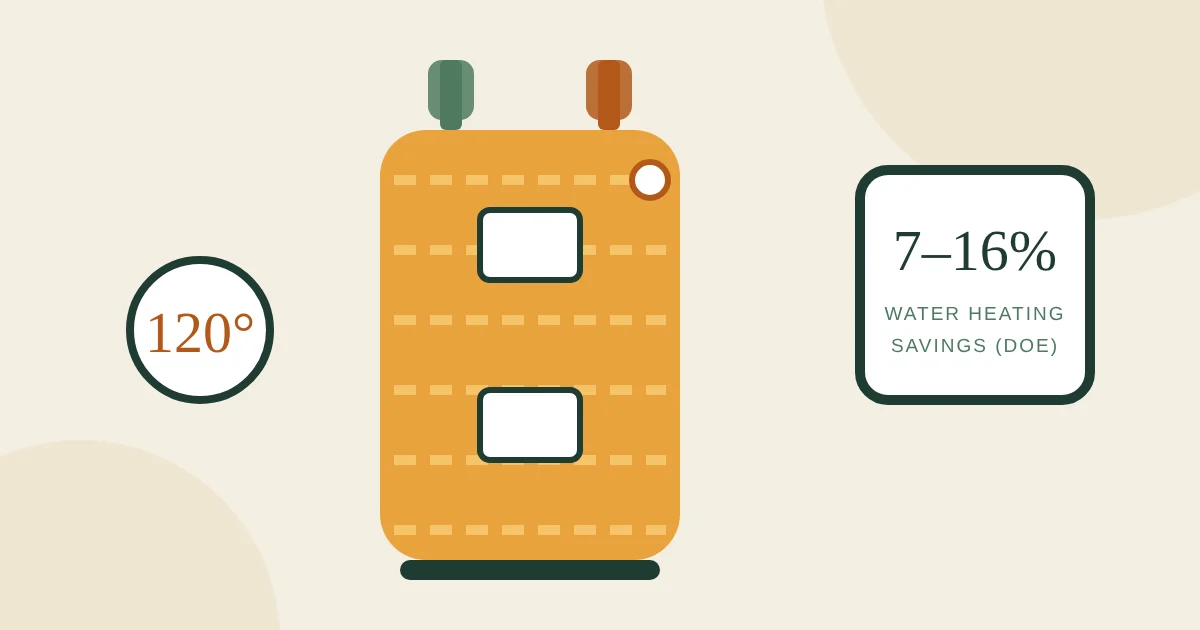
Most people think of the furnace or the air conditioner when the bill comes. But heating water is the second largest energy expense in a typical home: the Department of Energy puts it at about 18% of your utility bill. And the shower is where most of that hot water goes. A shower head that pours 2.5 gallons a minute is heating 25 gallons for a ten-minute shower, every day, for every person in the house.
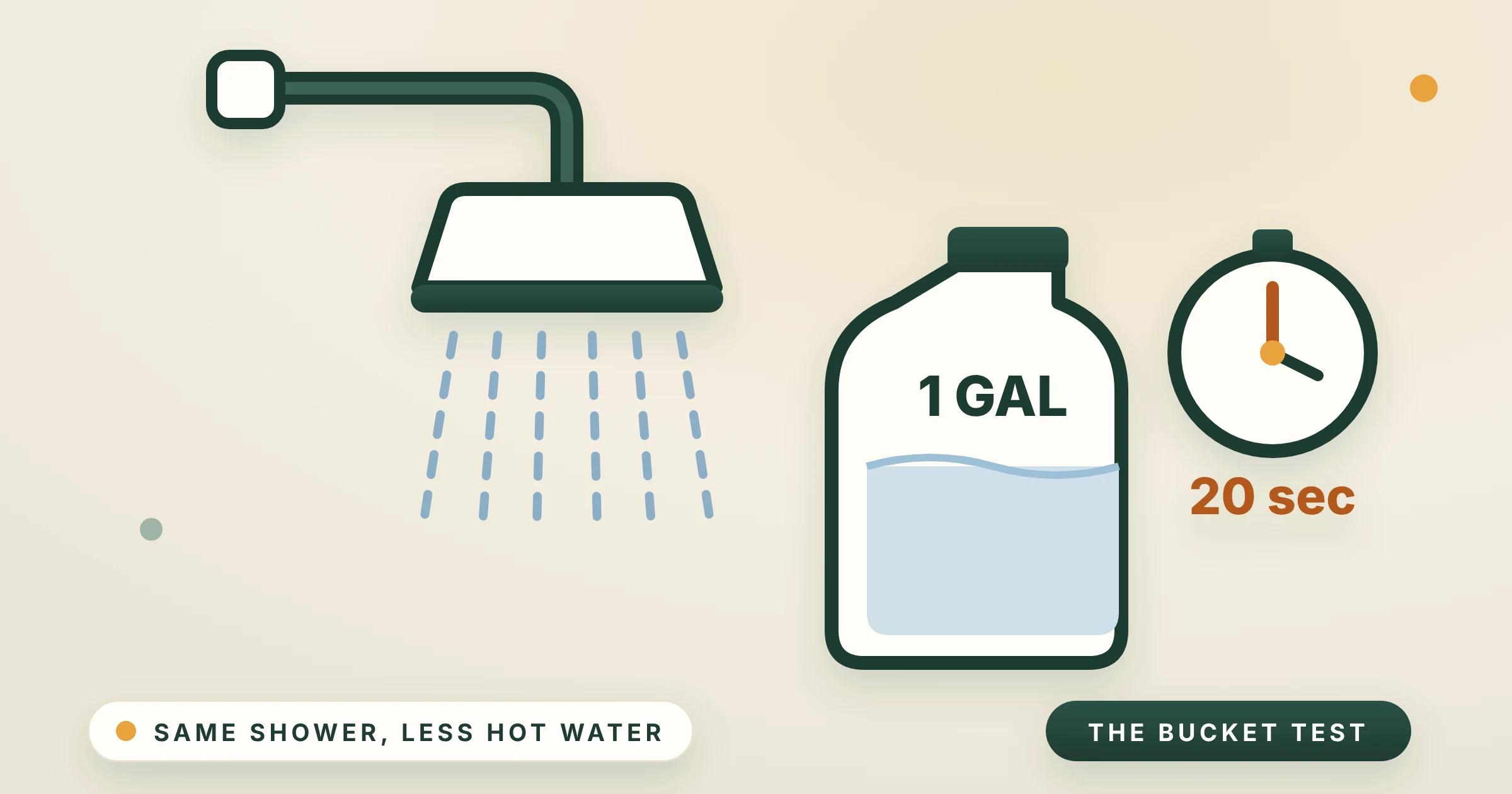
Do the 20-second bucket test first. If your shower fills a 1-gallon jug in less than 20 seconds, a WaterSense head will cut your hot water use without a weak shower. Our pick for a strong spray is the High Sierra Classic 1.5 gpm; for a handheld, the Niagara Earth Spa 1.5 gpm; for a big, gentle spray, the Moen Engage Magnetix 1.75 gpm. EPA estimates the switch saves a family about 2,700 gallons of water and more than 330 kWh of electricity a year.
Affiliate note: As an Amazon Associate, The Low Bill Home earns from qualifying purchases. Buying through our links costs you nothing extra. We have not tested every product hands-on: picks are based on the makers' published specs, official energy-saving guidance and long-term buyer feedback, and we say where a product falls short.
Single solid-metal nozzle, big heavy drops; WaterSense certified, made to resist clogging.
Check price on AmazonWhy we picked it ↓Three spray settings and pressure compensation that keeps the flow steady.
Check price on AmazonWhy we picked it ↓1.75 gpm, 5.5-inch face, six settings and a magnetic dock.
Check price on AmazonWhy we picked it ↓Shopping on Black Friday? Add it to your Amazon cart now so it is ready when the deals start (Black Friday is November 27, Cyber Monday November 30, 2026).
The 20-second bucket test
You do not need to know the model of your old shower head. The Department of Energy suggests a simple test: turn the shower on fully, hold a 1-gallon container under it and time how long it takes to fill. If it takes less than 20 seconds, you could benefit from a low-flow shower head. To get the flow rate, divide 60 by the seconds: 20 seconds is 3 gallons a minute, 24 seconds is 2.5.
Older homes are where the test pays off most. DOE notes that before 1992 some shower heads ran as high as 5.5 gallons per minute. Today's federal limit is 2.5, and heads with EPA’s WaterSense label use no more than 2.0.
What a new shower head saves
The water itself is only part of the saving. Every gallon you do not use is a gallon your water heater does not have to heat. EPA’s WaterSense program estimates that a family that switches to WaterSense shower heads saves about 2,700 gallons of water a year and more than 330 kilowatt-hours of electricity, the energy it no longer spends heating that water. At the U.S. average of about 18 cents per kWh that EIA expects for 2026, that is roughly $60 a year on an electric water heater, before the lower water and sewer bill.
That EPA figure assumes a switch from 2.5 to 2.0 gpm. Go from an older 2.5 gpm head to 1.5 gpm and the saving roughly doubles. Go from a pre-1992 head and it is bigger still. The calculator below works it out for your household.
| Switch | Gallons saved per 8-minute shower | Per year, 2 showers a day |
|---|---|---|
| 2.5 → 2.0 gpm | 4 | 2,920 gallons |
| 2.5 → 1.75 gpm | 6 | 4,380 gallons |
| 2.5 → 1.5 gpm | 8 | 5,840 gallons |
| 3.0 → 1.5 gpm | 12 | 8,760 gallons |
Shower savings calculator
How much would a new shower head save you?
How it works: about three quarters of shower water is hot water from the tank. Heating a gallon from about 55°F to 120°F takes about 0.17 kWh in an electric tank or about 0.009 therms in a gas tank. With EPA’s own case (2.5 to 2.0 gpm) this lands close to its 330 kWh estimate. The $10 water rate is only an example: use the combined water and sewer price on your bill.
1.5, 1.75 or 2.0 gpm?
| Flow | How it feels | Best for |
|---|---|---|
| 2.0 gpm (WaterSense maximum) | Close to a standard head | Thick or long hair, anyone worried about a weak shower |
| 1.75 gpm | Most people barely notice | The safe middle: real savings, few complaints |
| 1.5 gpm | Fine with a small face or a single strong stream; thin with a wide rain head | The biggest savings with a well-designed head |
| Below 1.5 gpm | Thin for many people | Guest baths, quick rinses, adjustable heads |
The flow rate is not the whole story. The same 1.5 gallons a minute feels very different through a 2-inch face than through an 8-inch rain head, which spreads the water thin. That is why every pick below either keeps the spray concentrated or uses pressure compensation to hold the flow steady.
How we chose
- WaterSense or under 2.0 gpm. Every pick is listed as WaterSense certified or compliant, at 1.5 to 1.75 gpm.
- A spray that does not feel weak. Concentrated nozzles, pressure compensation or a design built around low flow, not a standard head with a restrictor squeezed in.
- Fixed and handheld options. Many people want a handheld for cleaning the tub, rinsing kids or pets.
- Track record. Long-selling models with plenty of buyer feedback, especially complaints about clogging, drips and pressure.
- In stock with U.S. delivery when we checked on October 20, 2026.
We have not tested these products in our own home. Picks are based on the makers’ published specifications, WaterSense listings and patterns in long-term buyer feedback.
The picks
High Sierra Classic 1.5 GPM Shower Head
High Sierra takes a different approach from most low-flow heads: instead of dozens of tiny jets, a single solid-metal nozzle collides the water into a cascade of large, heavy drops. That is why it is the head most often recommended to people who have been disappointed by low-flow showers before: the drops carry more force, and they rinse shampoo out of long hair well. The maker says it is independently certified to WaterSense and that the single wide nozzle cannot clog with hard water, sand or rust. It is solid lead-free metal, made in the USA from domestic and imported parts, with a two-year warranty, and it fits any standard 1/2-inch shower arm.
- 1.5 gpm, WaterSense certified (per High Sierra)
- Single-nozzle, solid lead-free metal
- Swivel to set the spray angle
- Also sold with a trickle valve and at 1.25 or 1.8 gpm
- 2-year warranty
Good: the most forceful-feeling spray here, nothing to clog, built to last.
Watch out: one spray pattern only, and a narrower spray than a wide rain head; sold by the maker, not Amazon.
Skip it if: you want several spray modes or a handheld: choose the Niagara Earth Spa or the Moen.
Niagara Earth Spa 3-Spray 1.5 GPM Handheld (N2945CH)
Niagara Conservation has made water-saving fixtures for decades, and the Earth Spa is its everyday handheld. Its patented pressure compensation is the point: it holds the flow steady across a range of water pressures, so the shower does not collapse to a dribble when someone runs a tap. Three settings (needle, massage and a combination) come through a 2.7-inch face, small enough to keep the spray concentrated. The hose has a built-in backflow preventer; Niagara notes this can let a little water drip from the hose connection after you turn off the shower, which is normal, not a leak.
- 1.5 gpm, WaterSense compliant
- 3 settings: needle, massage, combination
- 2.7-inch spray face, pressure compensation
- Hose and wall holder included
Good: steady pressure, handheld convenience, low cost.
Watch out: plastic body (ABS with brass parts); the hose can drip briefly after a shower by design.
Skip it if: you want a large, rain-style spray: look at the Moen.
Moen Engage Magnetix 26100EP Handheld
If the idea of a small, sharp spray does not appeal, this is the compromise. Moen’s Engage Magnetix runs at 1.75 gpm, still well under the 2.5 gpm federal limit and WaterSense certified, through a 5.5-inch face with six settings, including a pause setting that cuts the flow while you lather. A magnetic dock snaps the handheld back into place without fiddling. It saves less than a 1.5 gpm head, but it is the one least likely to make anyone in the house complain.
- 1.75 gpm (6.65 L/min) max, WaterSense certified
- 6 settings including pause
- 5.5-inch spray face
- Magnetic docking; sold and shipped by Amazon
Good: wide, comfortable spray, pause button, a big-name brand with easy returns.
Watch out: a wide face at 1.75 gpm feels softer than a single-nozzle head; saves less than the 1.5 gpm picks.
Skip it if: you want the biggest savings: a 1.5 gpm head saves about a third more.
Niagara Tri-Max 0.5–1.5 GPM Fixed Head (N2615CH)
A small, inexpensive fixed head with a twist: you choose the flow. Turn the dial to 1.5, 1.0 or 0.5 gallons per minute, with Niagara’s pressure compensation keeping each setting steady. Use 1.5 for normal showers and drop to 1.0 for a quick rinse. The 2-inch face keeps the spray tight, and the ball joint swivels 360 degrees. It is a good fit for a guest bath, a rental you are paying the water bill for, or anyone who wants to push savings as far as they can.
- Adjustable 0.5 / 1.0 / 1.5 gpm
- Pressure compensation
- 2-inch face, 360° ball joint
- WaterSense compliant
Good: the lowest possible flow when you want it, steady pressure, low price.
Watch out: 0.5 gpm is a trickle for most people; a small face means a narrow spray.
Skip it if: you have a tankless water heater with a high minimum flow (see below).
How to install it in 10 minutes
- Unscrew the old head by hand, turning counterclockwise. If it is stuck, wrap a cloth around the nut and use pliers.
- Clean the threads on the shower arm: peel off old tape and wipe away scale.
- Add plumber’s tape if the maker calls for it, two or three turns, wrapped clockwise. (High Sierra says its heads need no Teflon tape; read the instructions in the box.)
- Screw on the new head by hand until snug. Over-tightening can crack plastic heads.
- Run the shower and check for drips at the connection. A quarter turn more usually fixes them.
- Repeat the bucket test. A 1.5 gpm head should take about 40 seconds to fill a gallon.
Before you buy
- Tankless water heaters need a minimum flow to switch on. Check the minimum activation flow in your heater’s manual before you go below 1.5 gpm.
- Older shower valves. If the water temperature swings after the swap, check the shower valve maker’s guidance: some valves are set up for a particular flow rate.
- Renters: keep the old head in a bag and put it back when you move out.
- Hard water: any head slowly clogs with scale. Soak it in white vinegar every few months to keep the spray strong.
- Do the cheap fix next: if you have an electric water tank that feels warm, a water heater blanket and pipe insulation cut the other half of the hot water waste.
FAQ
Do low-flow shower heads really save money?
Yes, mostly on the energy used to heat the water. EPA estimates that a family switching to WaterSense heads saves about 2,700 gallons of water and more than 330 kilowatt-hours of electricity a year. At about 18 cents per kWh that is roughly $60 of electricity for an electric water heater, plus the water and sewer savings, from a part that costs less than one month of the savings for many homes.
What gpm is a good low-flow shower head?
The federal maximum is 2.5 gallons per minute and WaterSense-labeled heads use no more than 2.0. Most people find 1.75 gpm feels close to normal, and a well-designed 1.5 gpm head still rinses well. Below 1.5 gpm the shower starts to feel thin for many people.
Why does my low-flow shower head feel weak?
Usually because the same water is spread over a big spray face, or because the head clogs with hard-water scale. A smaller face, a single strong stream or pressure-compensating heads feel stronger at the same flow. Soaking the head in vinegar removes scale.
How do I know my current shower head's flow rate?
Do the bucket test: turn the shower on fully and time how long it takes to fill a 1-gallon container. The Department of Energy says that if it takes less than 20 seconds, you could benefit from a low-flow head. Divide 60 by the seconds to get gallons per minute.
Will a low-flow head work with a tankless water heater?
Usually, but tankless heaters need a minimum flow to switch on, and some older units need more than others. Check the minimum activation flow in your heater's manual before you choose a very low-flow head.
Can I install a shower head myself?
Yes. Unscrew the old head, clean the threads on the shower arm, add plumber's tape if the maker calls for it, and tighten the new head by hand. If you need pliers, wrap the nut in a cloth so you do not scratch the finish.
Keep going
- Water heater blanket: is it worth it?
- Best electricity usage monitors to see what else is raising your bill
- 20 ways to lower your heating bill this winter
- Energy cost calculator
Sources

Email me at hello@thelowbillhome.com. I read every message, and when a rate, a rule or a product changes, I update the guide. — Eugene
Affiliate Disclosure: The Low Bill Home is a participant in the Amazon Services LLC Associates Program. As an Amazon Associate we earn from qualifying purchases, at no extra cost to you. Product details and availability change, so check the listing before you buy.