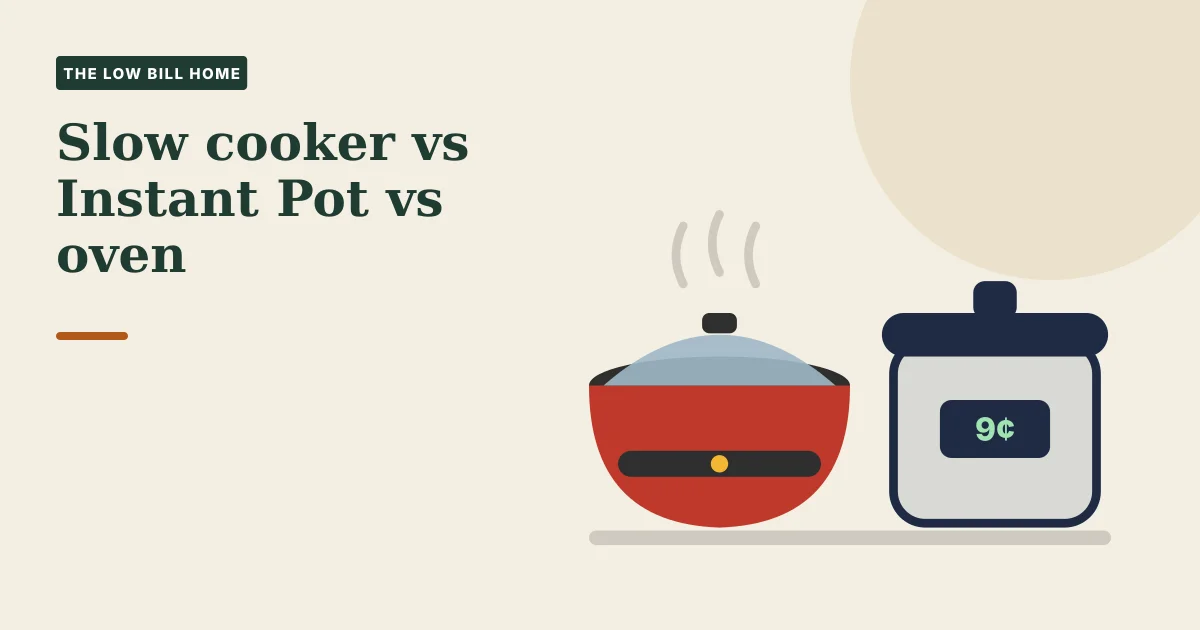
For a 3-pound pot roast, an Instant Pot uses the least energy, about 0.5 kWh or 9 cents. A slow cooker on low for 8 hours uses about 1.3 kWh, roughly 24 cents. An electric oven braising for 3 hours uses about 3 kWh, roughly 55 cents, and a gas oven about 40 cents. All four cost less than a dollar, so pick the method that fits your day; if you cook stews every week, the pressure cooker or slow cooker saves $15 to $25 a year over the oven.
Affiliate note: As an Amazon Associate, The Low Bill Home earns from qualifying purchases. Some links below are affiliate links, at no extra cost to you.
A pot roast in the oven is the classic Sunday dinner, and a 3-hour braise keeps a 2,500-watt element cycling the whole afternoon. The same roast in a slow cooker draws about a tenth of that power, just for much longer. And the pressure cooker finishes in about an hour.
So which is cheapest? I measured nothing fancy here: I used typical wattages, how much of the time each heating element actually runs, and 2026 average rates. The calculator lets you put in your own.
Calculator: cost per meal and per year
Estimates from typical appliances: slow cooker about 160 W average on low, Instant Pot 1,000 W element running about a third of the cook, electric oven 2,400 W element cycling about half the time after preheat, gas oven about 9,000 Btu per hour average. Your appliances will vary.
The numbers behind it
Wattage on the label is the maximum. Every one of these appliances switches its heating element on and off to hold a temperature, so what matters is the average power over the cook.
| Appliance | Pot roast time | Energy used | Cost* |
|---|---|---|---|
| Instant Pot (pressure cook) | about 90 min including pressure up and release | about 0.5 kWh | 9¢ |
| Slow cooker, low | 8 hours | about 1.3 kWh | 24¢ |
| Slow cooker, high | 4–5 hours | about 1.1 kWh | 20¢ |
| Electric oven, 325°F | 3 hours plus preheat | about 3 kWh | 55¢ |
| Gas oven, 325°F | 3 hours plus preheat | about 0.3 therm | 39¢ |
*At 18.2¢ per kWh and $1.30 per therm. A gas oven also uses a little electricity for the igniter; I left it out because it's under a cent.
One more thing the table doesn't show: in winter, the heat an oven leaks into the kitchen isn't entirely wasted if your heating is running anyway. In summer, it's a cost twice, because the air conditioner then has to remove it.
Which one to use when
- Weeknights: the Instant Pot. Cheapest and fastest; tough cuts get tender in about an hour.
- Workdays: the slow cooker. Load it in the morning, dinner is ready when you get home, and it costs about a quarter.
- Sunday with sides: if the oven is on anyway for rolls or a pie, braise the roast in it too. Filling a hot oven is the cheapest way to use one.
- Beans: the pressure cooker wins clearly: dried beans that take hours on the stove are done in under an hour.
For the rest of the kitchen, see air fryer vs oven cost per meal and what Thanksgiving dinner costs to cook.
Slow cooker food safety
The USDA's advice is simple and worth following: thaw meat before it goes in (frozen meat can sit too long in the temperature danger zone), keep the lid on, fill the cooker between half and two-thirds full, and if the power goes out while you're away, throw the food out. Cooked leftovers go in the fridge within two hours, not back into the slow cooker to reheat.
Picks
I haven't owned these exact models; picks are based on specs, materials and owner reviews.
| Pick | Why | What owners complain about |
|---|---|---|
| Best value slow cooker Crock-Pot 7-quart manual slow cooker usually $30–$45 | Big enough for a pot roast with vegetables, with simple low, high and warm settings. Nothing to break. Skip it if you already have an Instant Pot: its slow-cook mode does the same job. | The lid can rattle. Warm setting runs hot for some owners. |
| Fastest and cheapest to run Instant Pot Duo 6-quart usually $70–$100, often less on Black Friday | Pressure cooks a roast in about an hour, does beans without soaking, and slow-cooks when you want it to. Skip it if you only cook a stew now and then. | The sealing ring holds smells; buy a spare. Slow-cook mode runs cooler than a real slow cooker. |
| Spare sealing rings Instant Pot silicone sealing rings (2-pack) usually $10–$15 | One ring for savory food and one for desserts or yogurt. Cheap, and a worn ring is the most common reason a pot won't seal. Skip it if your ring is new. | Check the size: 6-quart rings don't fit 8-quart pots. |
| Check your own numbers P3 Kill A Watt P4400 energy meter usually $20–$30 | Plug the slow cooker or Instant Pot into it and read the exact kWh for a real recipe. Skip it if you're happy with the estimates above. It can't measure a 240-volt oven. | Small, dim display. |
Shopping for Black Friday? Add your pick to your Amazon cart now, so you can check the price again on November 27 and buy when it drops. Price ranges here are typical recent prices, not quotes.
FAQ
Is a slow cooker cheaper to run than an oven?
Yes. A pot roast uses about 1.3 kWh in a slow cooker on low versus about 3 kWh in an electric oven, roughly 24 cents versus 55 cents at 18.2 cents per kWh.
Does an Instant Pot use less electricity than a slow cooker?
Usually yes for the same dish, about 0.5 kWh versus 1.3 kWh for a pot roast, because it cooks for a much shorter time.
How much electricity does a slow cooker use in 8 hours?
A typical 6- to 7-quart slow cooker averages around 150 to 200 watts on low, so about 1.2 to 1.6 kWh over 8 hours.
Is it safe to leave a slow cooker on while at work?
Yes, if the cooker is in good condition, on a clear counter away from the edge, with the cord in good shape. The USDA says slow cookers are safe for unattended cooking when used as directed.
Can I put frozen meat in a slow cooker?
The USDA advises thawing meat first, because frozen meat can stay too long at temperatures where bacteria grow.
Sources
- USDA FSIS: Slow cookers and food safety
- U.S. Department of Energy: Estimating appliance energy use
- EIA: Winter Fuels Outlook 2026–27

Email me at hello@thelowbillhome.com. I read every message, and when a rate, a rule or a product changes, I update the guide.
Affiliate Disclosure: The Low Bill Home is a participant in the Amazon Services LLC Associates Program. Some links on this page are affiliate links; if you buy through them, I may earn a small commission at no extra cost to you.