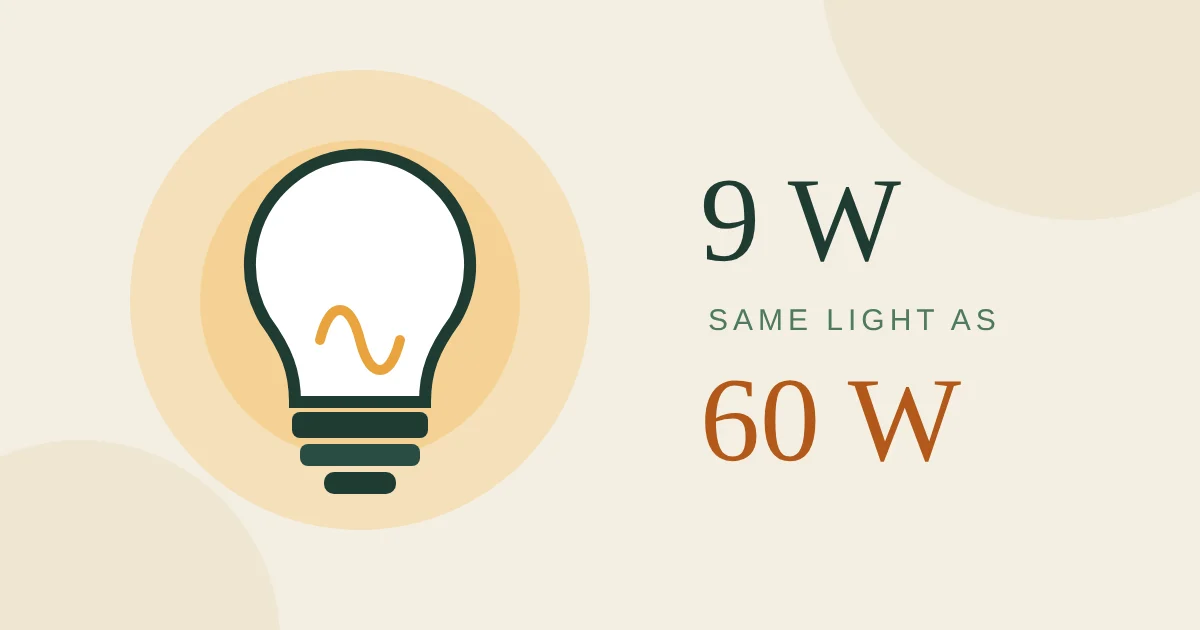
Lighting is the easiest part of an electric bill to cut, and it pays back faster than anything else in this guide. Every old 60-watt bulb you replace with a 9-watt LED uses about 85% less electricity for the same light. The Department of Energy says residential LEDs, especially ENERGY STAR rated products, use at least 75% less energy and last up to 25 times longer than incandescent lighting. Here is how much switching saves in your home, how to pick the right bulb so you do not hate the light, and the bulbs worth buying.
For lamps and ceiling lights in living rooms and bedrooms, get warm 2700K “soft white” bulbs of about 800 lumens to replace 60 watts. The Sylvania ECO 60W-equivalent 8-pack is the value pick. On a dimmer, buy bulbs labeled dimmable, like the GE Relax HD. For a garage, basement or workshop, cool 5000K daylight bulbs in bulk. Ten bulbs swapped from 60-watt incandescents save about $100 a year at average use.
Affiliate note: As an Amazon Associate, The Low Bill Home earns from qualifying purchases. Buying through our links costs you nothing extra. We have not tested every product hands-on: picks are based on the makers' published specs, official energy-saving guidance and long-term buyer feedback, and we say where a product falls short.
9 W, 750 lumens, warm 2700K. Non-dimmable.
Check price on AmazonWhy we picked it ↓Warm soft white with richer color. Works with most dimmers.
Check price on AmazonWhy we picked it ↓Bright, cool 5000K light in bulk for utility spaces.
Check price on AmazonWhy we picked it ↓Tip: start with the lights you use most. A bulb that is on for hours a day pays back in months; one in a closet can wait.
How much switching saves
For one bulb used 3 hours a day, every day, at 18¢ per kWh, close to the 2026 U.S. average residential rate:
| Swap | Old bulb per year | LED per year | You save per year |
|---|---|---|---|
| 60 W incandescent → 9 W LED | $11.83 | $1.77 | $10.05 |
| 43 W halogen → 9 W LED | $8.48 | $1.77 | $6.70 |
| 100 W incandescent → 14.5 W LED | $19.71 | $2.86 | $16.85 |
| Ten 60 W bulbs → ten 9 W LEDs | $118.26 | $17.74 | $100.52 |
The bulbs also last far longer. ENERGY STAR says certified LED bulbs use up to 90% less energy and last 15 times longer than standard bulbs, and that one certified bulb can save more than $55 in electricity over its life.
But doesn’t an old bulb help heat the room in winter? A little. It is resistance heat, the most expensive way to heat a home, and most of it collects at the ceiling. In summer the same heat makes your air conditioner work harder.
Your savings calculator
Enter how many bulbs you plan to swap, how long they are on and the rate on your bill.
Bulb swap savings calculator
Saves – kWh a year. The rate starts at 18¢, close to EIA’s 2026 U.S. average; change it to the rate on your bill. Old halogen “energy saver” bulbs are usually 43 W for a 60 W look.
How to choose: lumens, color, dimming
1. Brightness: buy lumens, not watts
Watts measure power, not light. The box lists lumens; match them to the bulb you are replacing.
2. Color: soft white or daylight
| Label | Color temperature | Looks like | Best for |
|---|---|---|---|
| Soft white | 2700K | Warm, like an old incandescent | Living rooms, bedrooms, lamps |
| Warm white | 3000K | Warm but crisper | Kitchens, dining rooms, bathrooms |
| Cool / bright white | 4000K | Neutral white | Kitchens, offices |
| Daylight | 5000K | Cool, bluish white | Garages, basements, workshops, laundry rooms |
If LED light has ever felt harsh or clinical to you, it was probably a daylight bulb in a living space. Keep the color the same within a room.
3. Dimmer or not
On a dimmer switch, buy bulbs labeled dimmable. Non-dimmable bulbs on a dimmer flicker, buzz or die early.
4. The fixture
Check the base (most U.S. household bulbs are E26 “medium”) and the shape (A19 is the standard bulb). In closed globes and recessed cans, look for “enclosed fixture rated” on the box, because heat shortens an LED’s life.
The picks
We have not tested these products in our own home. Picks are based on the makers’ published specifications, safety certifications and patterns in long-term buyer feedback, especially the complaints.
Sylvania ECO LED A19, 60W Equivalent (8-pack)
The bulb to buy for most lamps and fixtures that are not on a dimmer. Each one uses 9 watts for 750 lumens of warm 2700K soft white light, a direct replacement for a standard 60-watt bulb in look, if a touch dimmer. Sylvania rates them for up to 7 years and lists an estimated energy cost of about $1.08 a year at its standard usage assumptions. The 8-pack does a whole floor.
- 9 W, 750 lumens
- 2700K soft white, frosted
- Non-dimmable
- Up to 7-year life (maker’s rating), 8-pack
Good: warm, familiar light; large pack from a long-established brand.
Watch out: not for dimmers; 750 lumens is slightly dimmer than a full 800.
Skip it if: the fixture is on a dimmer switch: get the GE Relax or Linkind.
GE Relax HD LED, 60 Watt Replacement, Soft White
GE’s Relax HD bulbs are made for living spaces: warm soft white with what GE calls bolder colors and better contrast than standard LEDs, so skin tones and wood look natural. They are dimmable and work with most dimmer switches. A good choice for the living room and bedroom, where the quality of the light matters most.
- 60 W replacement, A19, E26 base
- Soft white
- Dimmable, works with most dimmers
- 4-pack
Good: pleasant warm light, dims smoothly on most dimmers.
Watch out: smaller pack; very old incandescent dimmers may still cause flicker.
Skip it if: you just need cheap light for a closet or hallway.
Linkind A19 LED, 60W Equivalent, Dimmable
A lower-cost dimmable option: 9 watts for a full 800 lumens at warm 2700K, with a medium E26 base. Linkind says the bulbs work with most LED dimmers and quotes a life of at least 13 years at 3 hours a day.
- 9 W, 800 lumens
- 2700K warm white
- Dimmable (most LED dimmers)
- E26 base, multipack
Good: full 800 lumens, dimmable, good price per bulb.
Watch out: less established brand than GE or Sylvania.
Skip it if: your dimmers are old incandescent models: check compatibility first.
Amazon Basics A19 LED, 60W Equivalent, Daylight (24-pack)
For the garage, basement, laundry room and workshop, cool 5000K daylight makes it easier to see what you are doing, and buying in bulk keeps the cost per bulb low. These are non-dimmable, standard E26 bulbs rated for 10,000 hours, or over 9 years at 3 hours a day according to Amazon.
- 60 W equivalent, A19, E26 base
- 5000K daylight
- Non-dimmable
- 10,000-hour rating, 24-pack
Good: bright, crisp light in bulk for every utility space.
Watch out: too cool and blue for most living rooms and bedrooms.
Skip it if: you want warm, cozy light: get soft white.
Sylvania ECO LED A19, 100W Equivalent (6-pack)
For reading lamps, kitchens and rooms that always feel dim. Each bulb gives 1,450 lumens of warm 2700K light from 14.5 watts, replacing a 100-watt incandescent and saving the most per bulb of any swap in this guide.
- 14.5 W, 1,450 lumens
- 2700K soft white, frosted
- Non-dimmable
- Up to 7-year life (maker’s rating), 6-pack
Good: a big jump in light for very little power.
Watch out: check the fixture’s wattage and enclosed-fixture limits; not dimmable.
Skip it if: the lamp shade or fixture is small and enclosed.
Which bulbs to switch first
- Kitchen and living room ceiling lights, usually on the longest each day.
- Porch and outdoor lights left on all evening or all night.
- Table and floor lamps you read by.
- Bathroom vanity bulbs, often four or more per fixture.
- Everything else as old bulbs burn out.
Want to see exactly what each light costs? A plug-in meter shows it; see our guide to electricity usage monitors.
Mistakes to avoid
- Daylight bulbs in the living room. 5000K feels harsh at night. Use 2700K.
- Non-dimmable bulbs on a dimmer. Flicker, buzz and early failure.
- Mixing colors in one room. Buy the same color temperature for every bulb in a fixture.
- Ignoring enclosed-fixture ratings. Trapped heat shortens LED life.
- Shopping by watts. Compare lumens.
FAQ
How much money do LED bulbs really save?
Swapping one 60-watt incandescent for a 9-watt LED used 3 hours a day saves about 56 kWh a year, roughly $10 at 18 cents per kWh. Ten bulbs save about $100 a year. ENERGY STAR estimates a single certified LED bulb can save more than $55 in electricity over its lifetime. If your old bulbs are 43-watt halogens, the saving per bulb is a little smaller.
What LED bulb replaces a 60-watt bulb?
Look for about 800 lumens, usually an 8 to 9-watt LED labeled “60W equivalent.” Lumens measure brightness; watts only measure power. Some bulbs sold as 60-watt equivalents give 750 lumens, slightly dimmer.
What is the difference between soft white and daylight?
Color temperature. Soft white (2700K) is the warm, yellowish light of an old incandescent and suits living rooms and bedrooms. 3000K is a slightly cleaner warm white. 4000K is neutral and 5000K “daylight” is cool and bright, better for garages, basements, laundry rooms and workspaces.
Can I use LED bulbs with a dimmer switch?
Only bulbs labeled dimmable. A non-dimmable LED on a dimmer may flicker, buzz or fail early. Old dimmers made for incandescent bulbs can also cause flicker with some LEDs; if that happens, an LED-compatible dimmer usually fixes it.
Do LED bulbs last as long as the box says?
Rated life assumes normal use. Heat shortens it, so use bulbs rated for enclosed fixtures in closed globes and recessed cans. The Department of Energy says residential LEDs, especially ENERGY STAR rated products, last up to 25 times longer than incandescent lighting.
Should I replace working incandescent bulbs or wait until they burn out?
Replace the ones you use most now: kitchen, living room, porch and any light left on for hours. A bulb used a few minutes a week can wait. The savings come from the hours a bulb is on.
Keep going
Sources
Affiliate Disclosure: The Low Bill Home is a participant in the Amazon Services LLC Associates Program. As an Amazon Associate we earn from qualifying purchases, at no extra cost to you. Product details and availability change, so check the listing before you buy.